
A pilot on our Discord said it best: “Having every single component be replaceable including the power source is huge.”
He was comparing Stratux to sealed commercial ADS-B receivers. When a Sentry’s battery dies in three years, you don’t replace the battery. You buy a new Sentry. The whole thing. $500+ gone.
With Stratux, you replace the $20 battery. Or the $10 antenna. Or the $30 SDR radio. One part at a time. Forever.
This isn’t an accident. Repairability is a design philosophy, and it’s the single biggest differentiator between Stratux and commercial aviation electronics.
The Framework Laptop Parallel
If you follow consumer tech, you’ve heard of Framework. They make laptops where every component is modular and user-replaceable. Battery, keyboard, ports, screen, motherboard—all swappable with basic tools.
It’s the opposite of modern electronics, where a cracked screen or dead battery means buying a whole new device.
Stratux follows the same philosophy, but for aviation.
What Makes Stratux Repairable?
No Proprietary Parts
Every component in a Stratux is a standard, off-the-shelf part:
- Raspberry Pi (the brain) — available from dozens of vendors worldwide
- RTL-SDR dongles (the radios) — commodity hardware, $10-25 each
- GPS module — standard USB receivers, widely available
- AHRS board — Raspberry Pi HAT using common sensors
- Battery pack — standard USB power banks
- Antennas — SMA connectors, universal threading
- Case — laser-cut acrylic or 3D-printed, designs are open-source
Nothing is locked down. Nothing is encrypted. Nothing requires a dealer tool or proprietary software.
No Glue, No Welds
Open a Sentry and you’ll find adhesive, potting compound, and a sealed enclosure. It’s designed to never be opened.
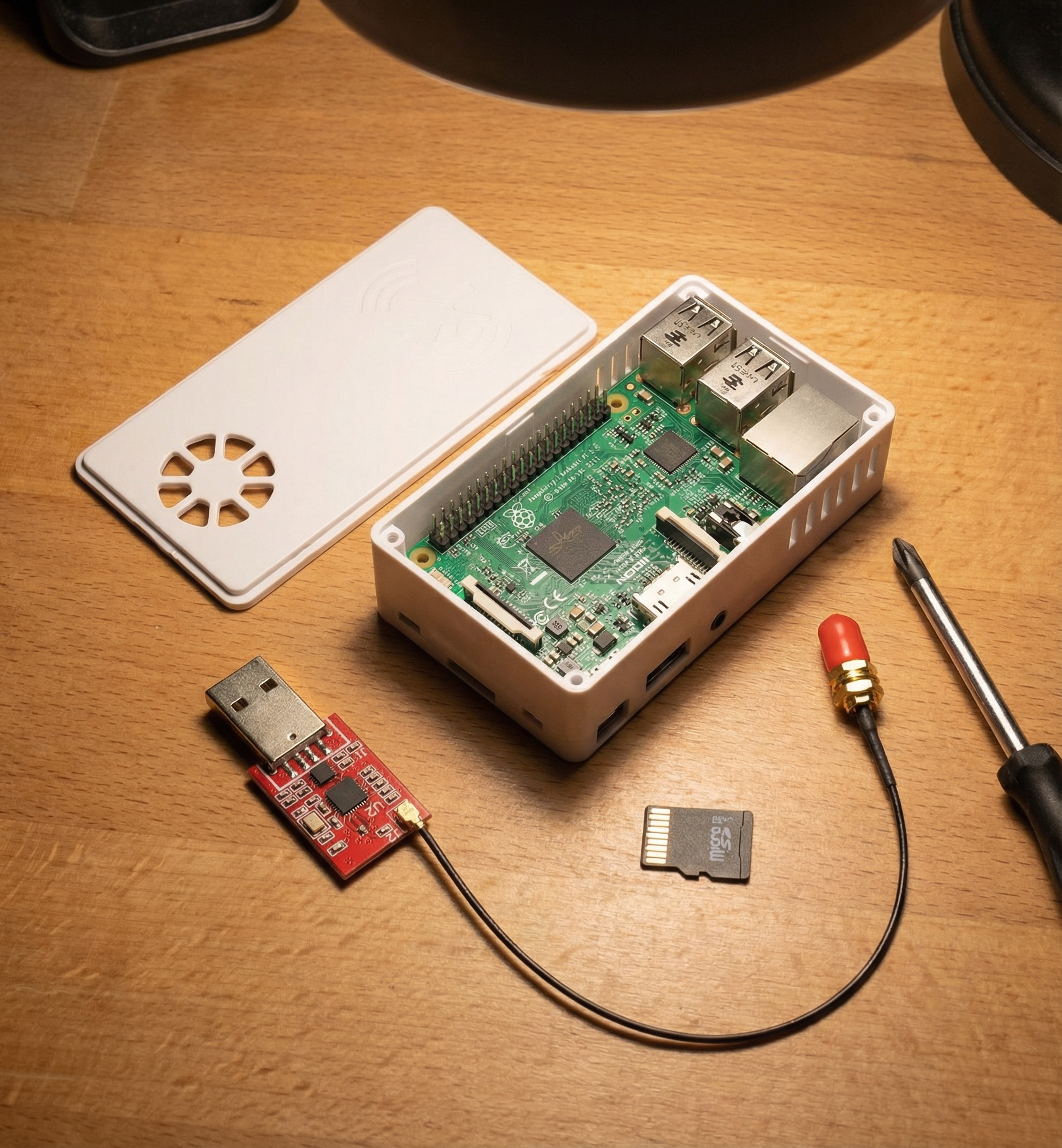
Open a Stratux and you’ll find screws. Four screws hold the case together. Components plug into standard USB and GPIO headers. The GPS module is friction-fit. The SDRs slide out. The Pi lifts out.
You can disassemble and reassemble a Stratux with the included mini screwdriver in about three minutes.
No Vendor Lock-In
Because the hardware is open-source and the software is community-maintained, you’re not dependent on a single company staying in business. If Crew Dog Electronics closed tomorrow, you could still:
- Download the Stratux firmware from GitHub
- Source replacement parts from Adafruit, Amazon, or AliExpress
- Get support from the Reddit and Discord community
- Build your own from scratch using the public schematics
This is the power of open-source hardware. The product outlives any single vendor.
What It Actually Costs to Repair
Let’s get specific. Here’s what each component costs if it breaks:
| Component | Replacement Cost | When You’d Replace It |
|---|---|---|
| Raspberry Pi 4 (2GB) | $35-45 | Never, unless physical damage or you want Pi 5 |
| 1090 MHz RTL-SDR | $25-35 | Antenna port breaks, SDR chip fails (~rare) |
| 978 MHz RTL-SDR | $25-35 | Same as above |
| GPS Module (VK-162) | $10-15 | Knocked loose (easy fix) or actual failure (~rare) |
| AHRS Board (BMP280/MPU9250) | $5-15 | Almost never—solid-state sensors |
| Battery (standard size) | $15-25 | Every 2-3 years (normal wear) |
| Battery (6-hour upgrade) | $25-35 | Every 2-3 years |
| Battery (12-hour upgrade) | $35-50 | Every 2-3 years |
| 978 MHz Antenna | $8-12 | Physical damage (stepped on, crushed) |
| 1090 MHz Antenna | $8-12 | Same as above |
| Cooling Fan | $5-10 | Almost never |
| MicroSD Card | $8-15 | Corruption (just reflash), or 2-3 years of writes |
| Case (acrylic) | $15-25 | Cracked in luggage, or you want a different color |
Total cost to replace everything: Around $200-250.
Cost of a new Sentry when the battery dies: $500+.
Cost of a new Stratux when the battery dies: $20.
Total Cost of Ownership
Let’s play this out over five years.
Commercial ADS-B Receiver (e.g., Sentry)
- Year 0: $500 (purchase)
- Year 3: $500 (battery non-replaceable, buy new unit)
- Year 6: $500 (repeat)
Total over 6 years: $1,500
Stratux
- Year 0: $250 (purchase a pre-built unit)
- Year 2: $25 (replace battery)
- Year 4: $25 (replace battery again)
- Year 5: $30 (upgrade to Raspberry Pi 5 because you want better performance)
Total over 6 years: $330
You’re not just saving money. You’re avoiding waste.
Real Repairs from Real Pilots
These are actual issues customers have brought to us, and how repairability saved them:
“GPS stopped working after a hard landing.”
Diagnosis: GPS module knocked loose from USB port.
Fix: Open case, push module back into USB slot. Optionally hot-glue in place.
Cost: $0.
Commercial receiver: Send it in for repair or buy new.
“Dropped my Stratux and cracked the case.”
Diagnosis: Acrylic case fractured.
Fix: Order new case ($20), swap internals in 5 minutes.
Cost: $20.
Commercial receiver: No case replacement available. Buy new unit.
“SDR antenna port broke off after years of use.”
Diagnosis: 978 MHz SDR pigtail connector failed.
Fix: Replace the $30 SDR dongle.
Cost: $30.
Commercial receiver: Internal antenna, not user-serviceable. Buy new unit.
“Want better GPS performance for AHRS.”
Diagnosis: Not a failure—pilot wanted an upgrade.
Fix: Swap internal GPS for external roof-mount GPS ($25).
Cost: $25 and 10 minutes.
Commercial receiver: Not possible.
Why This Matters Beyond Cost
Repairability isn’t just about saving money. It’s about control.
When you own a Stratux, you own the whole system. You understand how it works. You can diagnose issues. You can fix problems yourself, in the hangar, without shipping anything or waiting for a support ticket.
You wouldn’t fly an airplane you can’t inspect. Why use avionics you can’t open?
Sustainability and E-Waste
The aviation industry generates e-waste just like every other industry. Sealed units with non-replaceable batteries end up in landfills.
Stratux fights this in two ways:
1. Longevity through repair. Replace what breaks. Keep the rest.
2. Upgrade paths. When the Pi 4 came out, Stratux users swapped their Pi 3s. Same case, same SDRs, same GPS. Just a $40 upgrade instead of a $500 replacement.
Technology changes. Stratux adapts. Your sealed competitor box? Obsolete.
The Right-to-Repair Movement
Farmers can’t fix their own tractors. Hospitals can’t repair their own medical devices. Consumers can’t replace their own phone batteries—not without a heat gun and a prayer.
The Right-to-Repair movement is pushing back. The idea is simple: if you buy it, you should be able to fix it.
Stratux doesn’t just support Right-to-Repair. It embodies it.
Every schematic is public. Every component is documented. Every repair is possible. And if we ever disappeared, the community could continue without us.
What This Means for You
If you’re deciding between Stratux and a commercial receiver, ask yourself:
- Do you want to own your equipment, or rent it from a manufacturer?
- When the battery dies in three years, do you want to spend $20 or $500?
- Do you want the option to upgrade components, or buy entirely new units every few years?
- Do you value the ability to fix things yourself?
If the answer to any of those questions is yes, repairability matters.
Stratux isn’t just cheaper upfront. It’s cheaper over time, more sustainable, and more adaptable. It’s the Framework Laptop of aviation electronics.
And when something eventually breaks—because everything breaks—you’ll fix it for $20 instead of replacing it for $500.
That’s the philosophy. That’s the difference.