
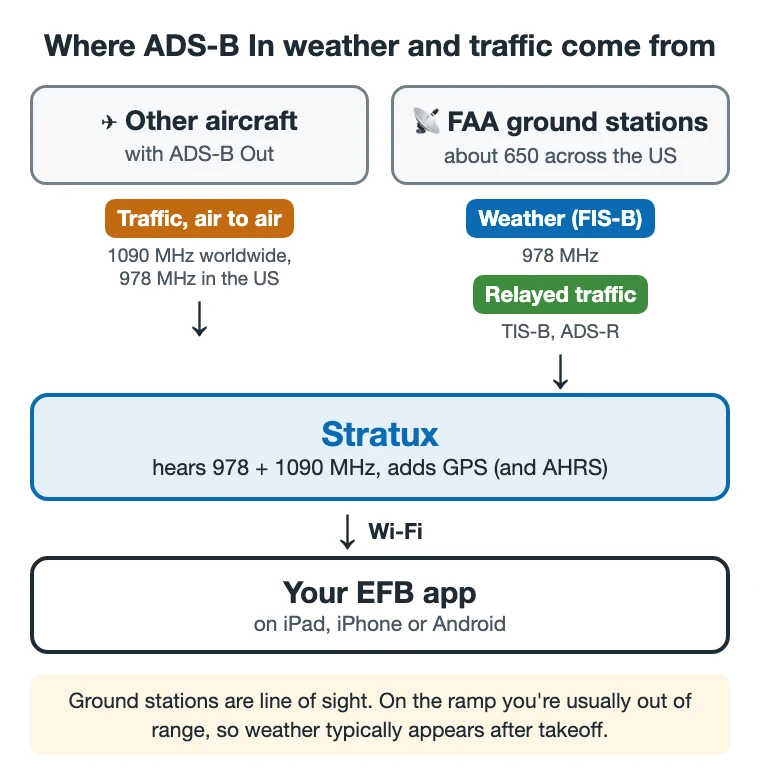
ADS-B In puts free weather and traffic on your tablet. FAA ground stations broadcast weather. Aircraft with ADS-B Out broadcast their positions. A receiver like the Stratux we sell hears both and sends them to your EFB app over Wi-Fi. There’s no subscription.
ADS-B Out is required. ADS-B In is optional.
ADS-B Out is the transmitter in your panel. Since January 1, 2020, the FAA rule (14 CFR 91.225) has required it in specific airspace: Class A, Class B, Class C, and most of Class E at and above 10,000 feet. ADS-B In is the receiver, and it’s optional. You can have it built into the panel, or carry a portable receiver that talks to your tablet.
What you get, free
- Weather (FIS-B): NEXRAD radar, METARs, TAFs, AIRMETs and SIGMETs, PIREPs, winds aloft and TFRs. Read about what each shows and how old it can be in ADS-B weather explained.
- Traffic: nearby aircraft, with position and altitude updated about once a second. Radar updates every 5 to 12 seconds.
Why you want both 978 and 1090 MHz
ADS-B uses two frequencies with different jobs. 978 MHz (UAT) carries FIS-B weather and relayed traffic from ground stations in the United States and parts of Canada. 1090 MHz (1090ES) carries traffic from other aircraft and works worldwide. Aircraft flying in Class A airspace must use 1090ES, so that’s where you’ll see most airliners and jets. A dual-band receiver hears both, so you get the most traffic available and weather where ground stations reach you. You still won’t see aircraft that don’t transmit.
On the ground vs. in the air
- No weather on the ramp is normal. Ground stations are line of sight, and the FAA runs about 650 of them. Weather usually appears once you have line of sight to a station, after you climb a bit.
- 1090 MHz traffic works on the ground, because other aircraft broadcast it directly.
- Relayed traffic (TIS-B and ADS-R) needs altitude and a ground station in range.

In the air, a Stratux on the windscreen hears ground stations and nearby traffic.
If your airplane doesn’t have ADS-B Out
You’ll still see every aircraft that broadcasts ADS-B Out directly, plus some relayed traffic that ground stations send for nearby aircraft. The FAA says that picture is incomplete. The full relayed service, a 15 nm “hockey puck” around you, needs your own qualified ADS-B Out. Either way, ADS-B traffic is advisory. Keep looking outside.
What to look for in a receiver
- Dual band (978 + 1090) for weather and the most traffic available.
- A WAAS GPS, so your EFB has a position even on a Wi-Fi-only iPad.
- AHRS for a backup attitude display. It isn’t certified for IFR. No portable AHRS is. It’s still a useful backup.
- Works with your app. Check before you buy. Will Stratux work with my EFB?
- Power for the whole flight, from a battery or a 2 A supply. See Power and batteries.
Every Crew Dog Stratux is dual band with WAAS GPS and AHRS. We assemble and test each one before it ships, and every part can be replaced. Compare the Crew Dog models.
Frequently asked questions
Do I need ADS-B In? No. The FAA requires ADS-B Out in specific airspace, listed in 14 CFR 91.225. ADS-B In is optional, and it gives you free weather and traffic in the cockpit.
Can I see traffic if my airplane has no ADS-B Out? Yes, partly. You’ll see aircraft that broadcast ADS-B Out directly, plus some relayed traffic. The full relayed picture needs your own ADS-B Out.
Why is there no weather on the ground? Weather comes from ground stations by line of sight. On the ramp you’re usually out of range. It typically appears after takeoff, once you have line of sight to a station.
Does ADS-B In work outside the United States? 1090 MHz traffic works worldwide. 978 MHz weather is available in the United States and parts of Canada.
Want the deeper version, with the airspace rules and how relayed traffic works? Read How ADS-B works on stratux.com.
Need a hand? Email support@crewdogelectronics.com or text 210-920-0568. We answer within one business day.