
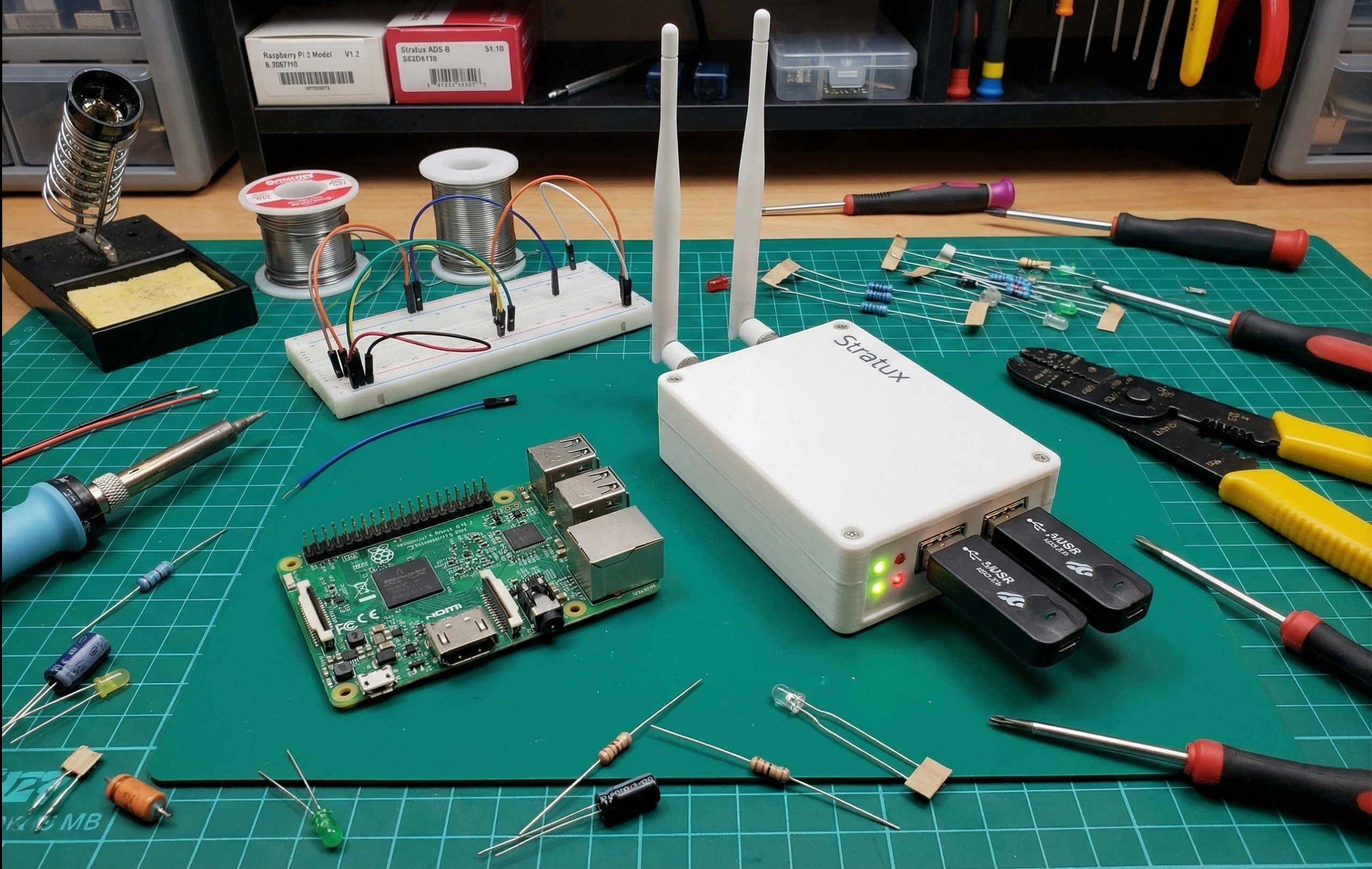
The Raspberry Pi 4 is the most powerful Pi available — faster CPU, more RAM, dual-band WiFi. It seems like the obvious choice for a Stratux build. The reality is more complicated. Stratux was designed primarily for the Pi 3B and Pi Zero W. Pi 4 support exists but comes with caveats you should understand before building. Here’s the current state as of 2026.
Short Answer
Yes, Stratux runs on Raspberry Pi 4. Community builds exist and work. But the Pi 3B+ remains the better choice for most Stratux builds, and the Pi Zero 2W is a strong option for size-constrained builds. Pi 4 has thermal and power draw issues that make it a worse fit for an aviation receiver than a better-spec’d SBC should be.
What Works on Pi 4
Core ADS-B reception
Both 978 MHz and 1090 MHz reception works on Pi 4. The SDR drivers that Stratux uses are compatible. Traffic display and FIS-B weather reception are functional.
WiFi and GPS
The Pi 4’s built-in WiFi works for Stratux’s access point mode. GPS modules connect via USB and are recognized without issues.
Web interface
The Stratux web interface at 192.168.10.1 works normally on Pi 4. Configuration, status monitoring, and firmware updates all function.
What Doesn’t Work Well on Pi 4
Heat is a real problem
The Pi 4 runs significantly hotter than the Pi 3B under load — the CPU can reach 80°C without active cooling. In a sealed enclosure in a summer cockpit (interior temps can hit 50–60°C on a hot day), a Pi 4 will thermal throttle and potentially shut down to protect hardware. The Pi 3B operates comfortably without active cooling at cockpit temperatures that would stress a Pi 4.
If you run Pi 4, you need a heatsink and ideally active cooling (a small fan). This adds complexity, power draw, and potential failure points to an aviation tool.
Higher power draw
Pi 4 requires a 5V/3A power supply minimum — more than the Pi 3B’s 5V/2.5A requirement. With two SDR dongles and a GPS module, your Pi 4 build may draw 2.5–3A sustained. This is harder to sustain from a power bank and runs batteries down faster. See our Stratux battery life guide for specific bank recommendations.
USB-C power connector pitfall
Pi 4 uses USB-C for power. Some USB-C cables are charging-only (no data) but work fine for power. However, if you use a USB-C hub or some USB-C power supplies, you may encounter the Pi 4’s known USB-C power delivery quirks. Use a quality USB-C power supply or cable rated for the Pi 4 specifically.
Community image availability
The main Stratux GitHub releases provide images for Pi 3B and Pi Zero W. Pi 4 images are community-maintained and may lag behind the official releases. Check the Stratux forums and GitHub issues for the current Pi 4 image before building.
Pi 4 vs. Pi 3B+ for Stratux: Head-to-Head
| Feature | Pi 4 | Pi 3B+ |
|---|---|---|
| CPU performance | Significantly faster | More than adequate for Stratux |
| RAM | 2–8GB | 1GB — sufficient for Stratux |
| Thermal management | Requires active cooling | Passive heatsink usually sufficient |
| Power draw | ~3A under load | ~2.5A max |
| WiFi | Dual-band (2.4/5GHz) | 2.4GHz only |
| Community support | Community images, less tested | Primary target, well-tested |
| Availability / cost | Widely available, higher cost | Widely available, lower cost |
Stratux doesn’t benefit from Pi 4’s extra CPU headroom — decoding two SDR streams is lightweight computation that a Pi 3B handles easily. The Pi 4’s advantages (speed, RAM) don’t matter for this application. Its disadvantages (heat, power) matter a lot in an aviation context.
Pi Zero 2W: The Better Alternative to Pi 4
For small, low-power builds, the Pi Zero 2W is a better choice than Pi 4. It runs Stratux well, has lower power draw than even the Pi 3B, and fits in a much smaller enclosure. Limitations: only one USB port (requires a USB hub for dual radio), and fewer GPIO pins for AHRS modules — but these are solvable.
If You Already Have a Pi 4
If you have a Pi 4 and want to run Stratux on it, it will work. Recommendations:
- Use a heatsink — don’t run bare
- Ensure adequate ventilation in whatever enclosure you use
- Use a quality 3A USB-C power supply
- Get the community Pi 4 Stratux image from the GitHub discussions (not the main release page)
- Test ground extensively before depending on it in flight
What We Build With
The Crew Dog Electronics Stratux units are built on Pi 3B hardware — the community-supported, thermally practical, well-tested choice for airborne Stratux. If you want a Pi 4-based build, that’s a DIY project. For a ready-to-fly unit that’s been tested and works reliably in cockpit conditions, our catalog is the path of least resistance.