
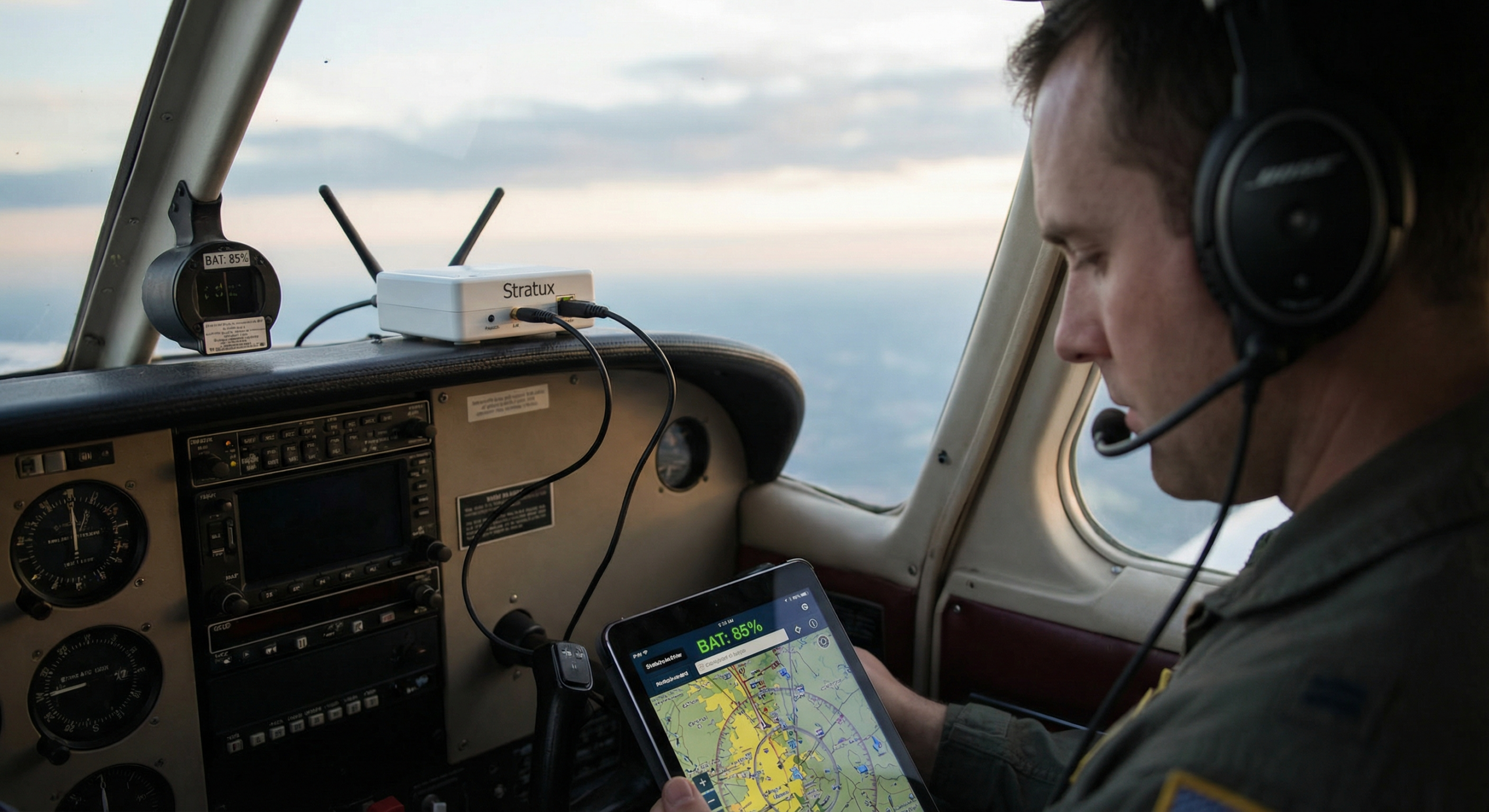
Stratux battery life depends on two things: how much current your build draws and how much capacity your power bank can deliver. A typical dual-radio Stratux setup pulls between 1.2–2.0 amps at 5V. Get the math right and you can run Stratux for 6–8 hours on a single charge. Get it wrong and you’re dark over the mountains at hour three.
Stratux Power Consumption: Real Numbers
Power draw varies based on your configuration:
- Raspberry Pi Zero W + single SDR: ~600–800mA
- Raspberry Pi 3B + dual SDR: ~1.0–1.4A
- Raspberry Pi 3B + dual SDR + AHRS (IMU): ~1.2–1.6A
- Pre-built CDE Stratux unit: ~1.0–1.3A typical
These are steady-state numbers. Startup spikes can hit 2A briefly, so your power source needs to handle that without dropping voltage. Don’t run USB power banks at more than 80% of rated output capacity for sustained use.
How to Calculate Runtime
The formula: Runtime (hours) = Battery capacity (mAh) ÷ Draw (mA) × 0.85
The 0.85 factor accounts for USB conversion losses. Real-world examples:
- 10,000mAh bank at 1,200mA draw: 10,000 ÷ 1,200 × 0.85 = 7.1 hours
- 10,000mAh bank at 1,600mA draw: 10,000 ÷ 1,600 × 0.85 = 5.3 hours
- 5,000mAh bank at 1,200mA draw: 5,000 ÷ 1,200 × 0.85 = 3.5 hours
Best Power Banks for Stratux — 2026 Recommendations
Under 4-Hour Flights: 10,000mAh
The Anker 325 (10,000mAh) is the standard community recommendation. It outputs 2.4A on USB-A, handles startup spikes cleanly, and fits in a shirt pocket. Around $22. Tested with dual-radio Pi 3B setups for 6+ hours with margin to spare.
What to avoid: No-name banks that advertise 10,000mAh but deliver 6,000mAh effective. Stick to Anker, Ravpower, or Baseus for consistent output.
4–8 Hour Flights: 20,000mAh
The Anker PowerCore 20100 is the go-to for transcontinental or long cross-country flights. Dual USB-A ports let you charge your iPad simultaneously. At 1,300mA Stratux draw, you get 13+ hours theoretical. Real-world: expect 10–11 hours before the bank starts current-limiting.
TSA allows power banks up to 100Wh carry-on. A 20,000mAh / 3.7V bank = 74Wh — well within limits. Carry-on only, not checked baggage.
Permanent Panel Mount: USB Power Supply
Wire a quality USB supply to the avionics bus (switched with master). Use a 3A supply with noise filtering — cheap supplies can inject interference into your 978/1090 receivers. Look for aviation-grade units rated for 9–32V input if your bus voltage varies.
Power Bank Features That Matter for Aviation
Pass-through charging
Can the bank charge while outputting power? Critical if you want to top off during flight via the aircraft USB port. Cheap banks do this poorly and cause Stratux to restart mid-flight.
Low-current mode
Some banks auto-shutoff if they detect low current draw. Pi Zero setups (~600mA) can trigger this. Look for banks without low-current shutoff, or use a Pi 3B which draws enough to keep the bank alive.
Output port rating
Look for 5V/2.4A or higher. Many budget banks only do 5V/1A on one port — insufficient for Stratux under load.
Cable Matters Too
A bad USB cable drops 0.3–0.5V under load. At 5V nominal, that puts you at 4.5–4.7V — into the voltage warning zone for Raspberry Pi. Symptoms: random reboots, GPS lock drops, the Pi voltage warning icon. Use a quality cable rated for at least 3A, under 3 feet. A $6 cable fix often solves what looks like a power bank problem.
Monitoring Power During Flight
The Stratux web interface (connect to the Stratux WiFi, navigate to 192.168.10.1) shows system status including low-voltage warnings. Check it before departure and after the first 30 minutes when the system is warm.
Ready-to-Fly Stratux Units
If you’d rather skip the power optimization trial-and-error, the Crew Dog Electronics Stratux receiver ships tested and ready to fly. Pair with any quality 10,000mAh+ Anker bank and you’re airborne.
Bottom Line
- Dual-radio Stratux: budget for 1.2–1.6A sustained draw
- 10,000mAh bank = 5–7 hours typical — enough for most GA flights
- 20,000mAh bank = 10+ hours — for long cross-countries or insurance
- Use quality banks — not whatever was cheapest on Amazon
- Check your cable — it causes more problems than pilots expect