
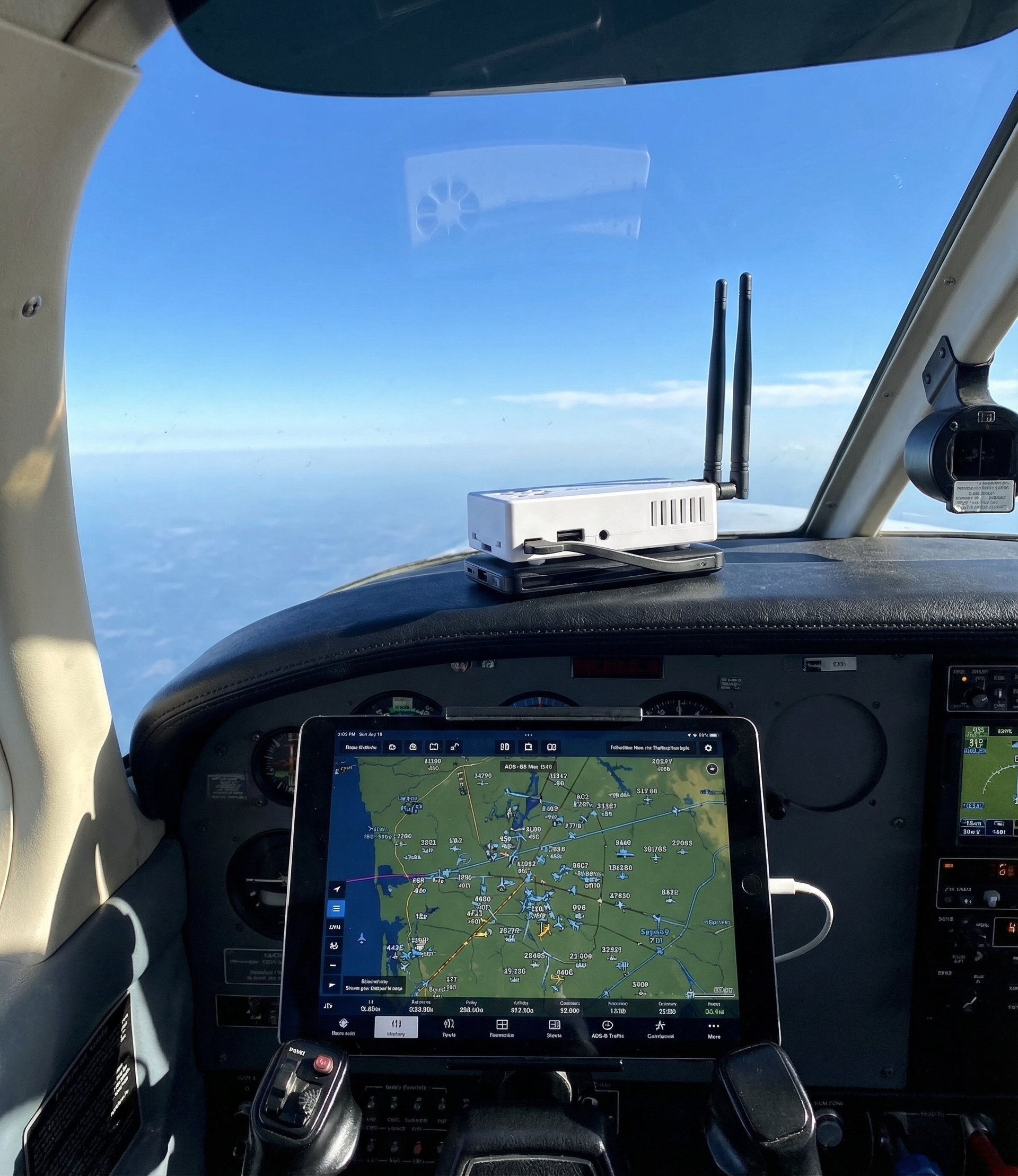
A dual-radio Stratux receives both 978 MHz UAT and 1090 MHz Extended Squitter. A single-radio build receives only one. Whether you need both depends on where you fly and what you want from the system. Here’s the straight answer.
What’s on 978 MHz (UAT)
978 MHz is the US-only UAT (Universal Access Transceiver) frequency. Two important things broadcast here:
FIS-B Weather
All ADS-B weather data — NEXRAD radar, METARs, TAFs, PIREPs, AIRMETs, SIGMETs, TFRs — broadcasts on 978 MHz. If you want free in-cockpit weather from the FAA’s FIS-B service, you need a 978 MHz radio. This is non-negotiable. There is no FIS-B on 1090 MHz.
UAT Traffic
Aircraft equipped with ADS-B Out on UAT broadcast their position on 978 MHz. In the US, general aviation aircraft at or below 18,000 feet may use UAT. Many do, especially those that added low-cost UAT transceivers to meet the 2020 mandate. If you want to see UAT-equipped aircraft on your traffic display, you need a 978 MHz radio.
What’s on 1090 MHz (Extended Squitter)
1090 MHz ES is the international ADS-B frequency. Everything above 18,000 feet in the US uses 1090 MHz ES — airline traffic, military (when broadcasting), international general aviation, and US GA aircraft that chose a 1090 ES transponder upgrade over UAT.
1090 MHz Traffic
If you fly in busy airspace (Class B approach corridors, areas with significant airline traffic), a lot of the traffic you care about is on 1090 MHz. Airlines all use 1090 ES. A significant portion of GA aircraft, especially those with glass panel upgrades, use 1090 ES transponders.
Without a 1090 MHz radio, you’re missing this traffic entirely on your iPad display.
The Answer: Dual Radio Is Worth It
If you want FIS-B weather (almost everyone does), you need 978 MHz. If you want to see airline traffic and 1090-equipped GA aircraft (almost everyone does), you need 1090 MHz. That’s two radios.
The cost difference between a single-radio and dual-radio Stratux build is the cost of a second RTL-SDR dongle — roughly $25–35. The capability difference is significant. There’s rarely a good reason to build or buy a single-radio Stratux for in-flight use.
Exception: 978-Only Makes Sense in Specific Cases
A single 978 MHz radio makes sense if:
- You’re building a ground-based weather station or ADS-B feeder (not a flight tool)
- You’re in a remote area with almost no airline traffic and you specifically only want weather
- You’re experimenting with the platform and cost-minimizing your prototype build
For an airborne receiver intended for situational awareness in any airspace with traffic, dual-radio is the correct configuration.
Exception: 1090-Only Makes Sense If Flying Above 18,000 Feet
FIS-B weather is only broadcast below 18,000 feet. Above FL180, FIS-B reception is unreliable. Aircraft above 18,000 feet also all use 1090 MHz ES (UAT is restricted to below FL180). If you’re flying IFR at altitude, a 1090-only radio gives you the traffic you care about. You’d be giving up FIS-B weather, but FIS-B coverage at altitude is spotty anyway.
For typical VFR and IFR flying below 18,000 feet, dual radio is the right choice.
Power and Space Considerations
The only real downsides to dual radio:
- Power draw: Each SDR dongle adds ~300–400mA. Dual radio adds roughly 600–800mA to total draw vs. single. This is meaningful for battery-powered builds — budget accordingly. See our battery life guide for power bank recommendations.
- Heat: Two SDRs run warmer. In a sealed enclosure without airflow, thermal management matters. Well-designed builds (including CDE units) account for this.
- USB ports: Pi Zero W only has one USB port — you need a USB hub for dual radio. Pi 3B+ has four ports; no hub needed.
What About Dual-Band Dongles?
There are SDR dongles that claim dual-band reception. For ADS-B purposes, these do not replace two separate radios. The SDR architecture requires dedicated tuning to a single frequency at a time — you can’t simultaneously receive 978 and 1090 from one dongle. Stratux uses two separate dongles, each tuned to its frequency, for genuine simultaneous reception.
Ready-to-Fly Dual-Radio Units
The Crew Dog Electronics Stratux units ship with dual-radio configuration — both 978 MHz and 1090 MHz — tested and ready to fly. No sourcing two separate dongles, no USB hub wrangling, no configuration. Power it on, connect your iPad, get traffic and weather.
Bottom Line
- 978 MHz: required for FIS-B weather and UAT traffic
- 1090 MHz: required for airline traffic and 1090-ES equipped GA aircraft
- Dual radio: the right configuration for airborne use in any shared airspace
- Cost difference: ~$25–35 more in hardware for double the coverage