
If you’re new to flying or recently got back in the cockpit after a few years away, you’ve probably heard the term “ADS-B” thrown around. Maybe your instructor mentioned it, or you saw other pilots with tablets showing traffic. Here’s what you need to know.
The Simple Version
ADS-B stands for Automatic Dependent Surveillance-Broadcast. Strip away the jargon and it means this: modern aircraft continuously broadcast where they are, and ground towers rebroadcast that information along with free weather data.
No radar ping. No controller asking your position. The aircraft tells everyone, automatically, about once per second.
Why the FAA Mandated It
As of January 1, 2020, the FAA requires ADS-B Out in most controlled airspace. The reason is straightforward: radar is old technology. It’s expensive to maintain, coverage has gaps, and it only works where there are radar sites.
ADS-B flips the model. Instead of ground stations painting you with radar, your aircraft broadcasts its own position using GPS. Air traffic control sees you. Other aircraft see you. The system works over oceans, in remote areas, anywhere with GPS coverage.
It’s more accurate, more reliable, and cheaper to run. That’s why it’s now the backbone of the US airspace system.
ADS-B Out vs ADS-B In: What’s the Difference?
This is where it gets interesting for GA pilots.
ADS-B Out means your aircraft is broadcasting. If you fly in Class A, B, or C airspace (or above 10,000 feet), you must have ADS-B Out equipment installed. This is the mandate everyone had to comply with by 2020.
ADS-B In means you’re receiving. This is optional, but it’s incredibly useful. With an ADS-B In receiver, you can see:
- Traffic: Other aircraft broadcasting their position
- Weather: Free NEXRAD radar, METARs, TAFs, TFRs, winds aloft
ADS-B In is not required. But if you’ve ever paid for XM Weather or wanted real-time traffic awareness without a $10,000 panel mount, this is the solution.
The Two Frequencies: 1090 MHz and 978 MHz
ADS-B operates on two frequencies in the US, and understanding the difference matters.
1090 MHz (Mode S Extended Squitter)
This is the international standard. Airliners, jets, and most transponder-equipped aircraft broadcast on 1090 MHz. It works worldwide, even over oceans.
If you’re sitting on the ground with an ADS-B receiver, you’ll see 1090 MHz traffic directly—no altitude required. You’re picking up the broadcasts from aircraft themselves.
978 MHz (UAT – Universal Access Transceiver)
This is a US-only frequency, limited to aircraft flying below 18,000 feet. The cool part: FAA ground towers broadcast on 978 MHz. They rebroadcast nearby traffic (including 1090 MHz aircraft you can’t hear directly) AND send free weather data called FIS-B.
The catch: 978 MHz is line-of-sight. On the ground, you won’t receive it—terrain, buildings, and the curvature of the earth block the signal. But once you’re around 1,000 feet AGL, you’ll start picking up the towers and the weather flows in.
What You Get for Free
When you have an ADS-B In receiver and you’re flying at altitude, the FAA’s ground network sends you:
- NEXRAD radar imagery (regional and CONUS)
- METARs (current airport weather)
- TAFs (terminal forecasts)
- PIREPs (pilot reports)
- TFRs (temporary flight restrictions)
- Winds aloft
- NOTAMs
This is the same data pilots used to pay $500+/year for via XM Weather. Now it’s free, courtesy of the FAA’s ADS-B infrastructure.
No subscription. No cellular connection. Just your receiver and the sky.
How Does Stratux Fit In?
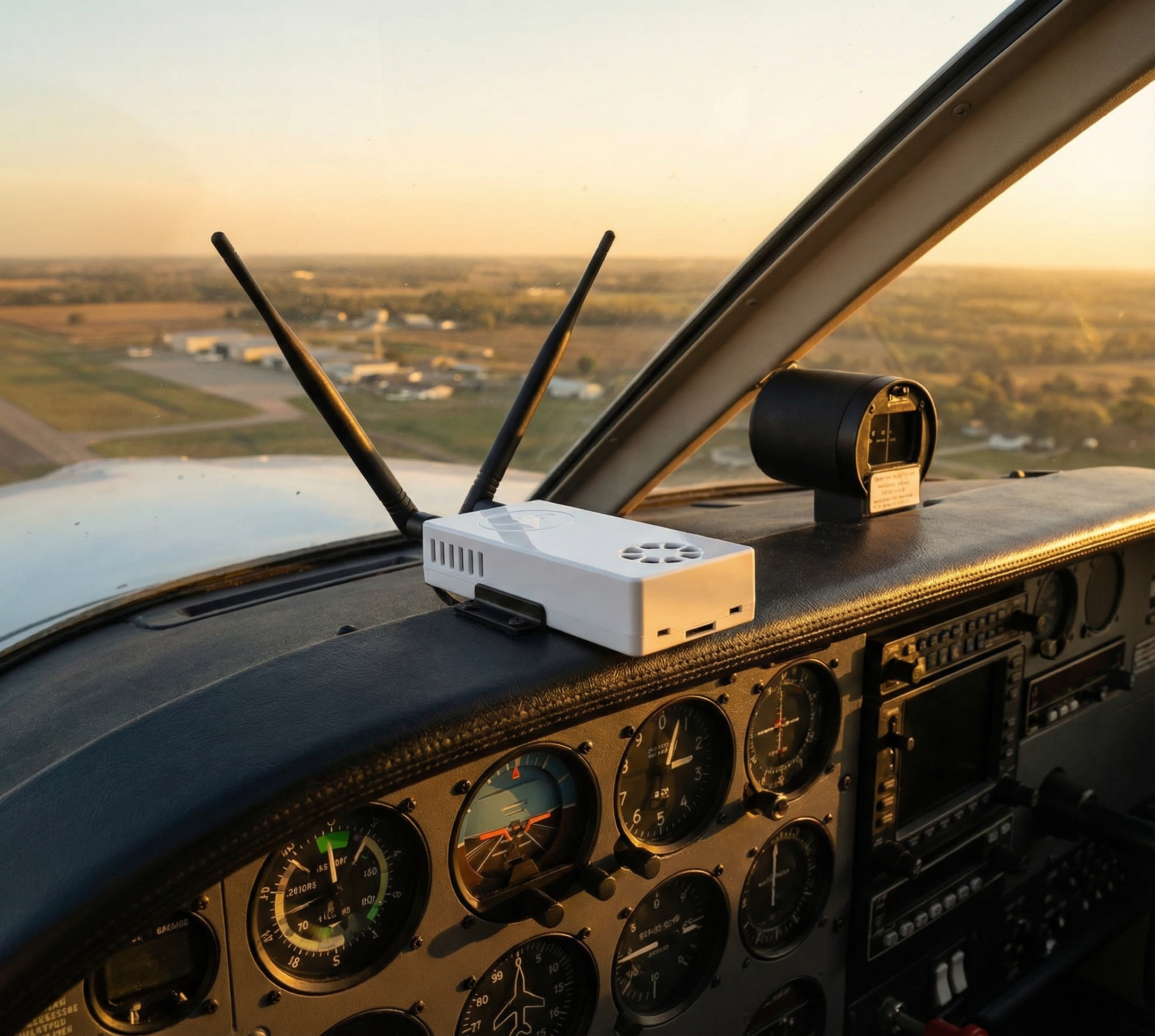
Stratux is a portable ADS-B In receiver. It listens to both 1090 MHz and 978 MHz, decodes the data, and sends it to your tablet or phone via WiFi. Your EFB app—ForeFlight, Avare, FlyQ, iFly, SkyDemon—displays the traffic and weather just like a built-in system.
The difference: Stratux costs a fraction of commercial ADS-B receivers, and because it’s open-source, you’re not locked into a single vendor or app.
What Stratux Does
- Receives 1090 MHz traffic directly from aircraft
- Receives 978 MHz traffic and weather from FAA ground towers
- Includes GPS for your position (great for WiFi-only iPads)
- Optional AHRS module for synthetic vision and attitude display
What Stratux Doesn’t Do
Stratux is an ADS-B In receiver. It does not transmit. It won’t fulfill your ADS-B Out mandate. If you need ADS-B Out, you’ll need a certified transponder installed by an avionics shop.
But for situational awareness—seeing traffic, getting weather, adding GPS and AHRS to your tablet—Stratux does the job for a few hundred dollars instead of a few thousand.
Who Benefits Most from ADS-B In?
Not everyone needs an ADS-B receiver, but these pilots get the most value:
VFR pilots in busy airspace: If you fly near Class B or C airports, seeing traffic before your instructor or controller calls it out is huge for situational awareness.
Cross-country fliers: Free weather beats guessing. NEXRAD on your tablet lets you see buildups, route around weather, and make better go/no-go decisions.
Pilots with WiFi-only iPads: If your tablet doesn’t have GPS, Stratux provides position for your moving map.
Budget-conscious aviators: Flight training and aircraft ownership are expensive. ADS-B In receivers put professional-grade situational awareness tools in reach for a few hundred bucks, not a few thousand.
Common Questions from New Pilots
“Will I see all the traffic around me?”
Not quite. You’ll see aircraft that have ADS-B Out (required in most controlled airspace). You won’t see older aircraft without ADS-B, gliders, ultralights, or aircraft not required to have it.
That said, the FAA’s TIS-B service rebroadcasts some radar-tracked aircraft on 978 MHz if you have ADS-B Out yourself. The coverage is good and getting better every year.
“Do I need altitude for it to work?”
For 1090 MHz traffic: No. You’ll see aircraft broadcasting on 1090 MHz even sitting on the ramp.
For 978 MHz traffic and weather: Yes. The ground towers are line-of-sight, so you need to be airborne—typically 1,000 feet AGL or higher.
“Can I use this instead of a weather briefing?”
ADS-B weather is excellent for en-route updates, but it’s not a substitute for a proper preflight briefing. The data can be delayed (up to 5 minutes for NEXRAD), and not all weather products are included.
Use ADS-B weather as a supplement, not a replacement.
The Big Picture
ADS-B is now the foundation of the US airspace system. The mandate pushed everyone to upgrade, but the side benefit is free traffic and weather for anyone with a receiver.
You don’t need to spend thousands on a panel-mount system. A portable ADS-B In receiver like Stratux gives you traffic awareness, real-time weather, GPS, and optional synthetic vision—all for the cost of a few hours of rental time.
Whether you’re a student pilot, a weekend warrior, or someone flying serious cross-countries, ADS-B In is one of the best cockpit upgrades you can make.