
The Real Price of ADS-B In (Most Pilots Get This Wrong)
Here’s how the math usually goes: a pilot decides they want ADS-B In traffic and weather. They look at a few options, pick a unit in the $300-600 range, and think they’re done. Sticker price. Done.
Eighteen months later, they’ve paid the sticker price plus a year of EFB subscription fees, a replacement battery that voided the warranty, and a customer service experience that involved being told the hardware was “end of life.”
The upfront price and the total cost of ownership are two different numbers. This post breaks down both.
What Commercial ADS-B In Receivers Actually Cost Over Time
Let’s start with the honest version of the commercial receiver budget.
Hardware: $299 to $699
Portable ADS-B In receivers are widely available in this range. Some are single-band UAT only (978 MHz). Others are dual-band, covering both UAT and 1090-ES transponder traffic. Most use internal GPS. They’re compact, polished, and they work.
EFB Subscriptions: $100 to $250/year
This is where the sticker price model breaks down. Most commercial ADS-B In receivers are designed to work with a specific EFB, and that EFB has a subscription. ForeFlight® starts at $99.99/year for basic and runs up from there. Other apps have similar tiers. The receiver itself may be “free” with an annual subscription in some bundle deals, which tells you something about the real economics.
The ADS-B data itself is free. It comes from FAA ground stations. But the software layer that displays it to you? That’s a recurring fee.
Repairs and Replacements: $0 Until It Isn’t
Sealed consumer electronics have a predictable failure curve. GPS receivers lose signal sensitivity over time. Lithium batteries degrade. Cases crack. Connectors corrode.
When that happens with a sealed unit, your options are usually: send it back under warranty (if you’re within the window), pay for depot repair at 40-70% of replacement cost, or just buy a new one. The “just buy a new one” option is priced in to the business model.
The Five-Year Number
Run the math on a typical commercial portable ADS-B In receiver over five years:
- Hardware: $499
- EFB subscription at $150/year x 5 years: $750
- One battery/repair event: $100 (conservative)
- Total: $1,349
That’s a number most pilots don’t see on the product page.
The Stratux Cost Model: One Number, No Surprises
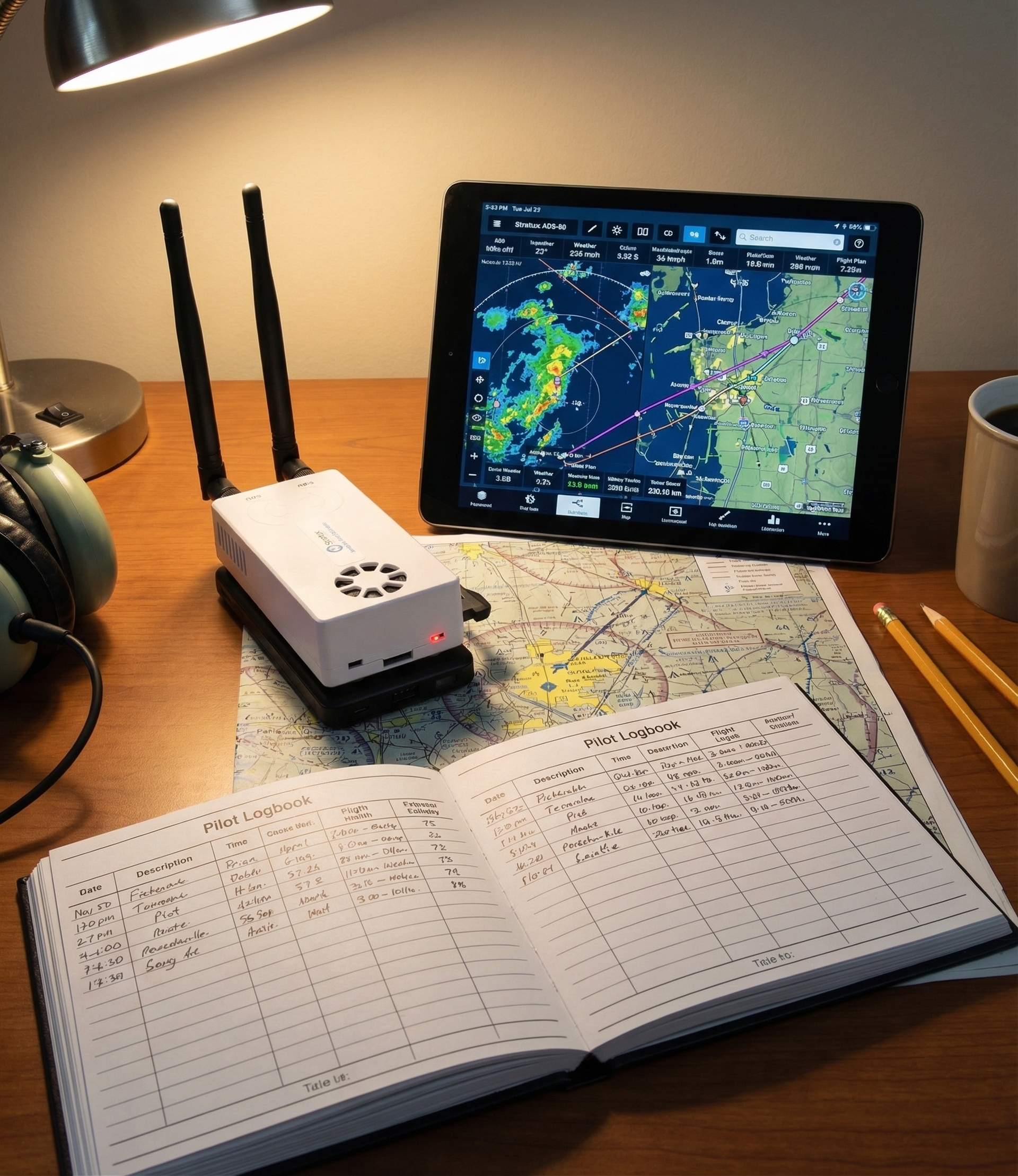
Stratux is an open-source ADS-B In receiver. The pre-built Crew Dog Electronics unit comes assembled, tested, and ready to fly. Here’s what the cost structure looks like.
Hardware: $379 to $439.99
The Stratux pre-built with internal GPS starts at $439.99. That includes the dual-band receiver (both UAT 978 MHz and 1090-ES 1090 MHz), the WAAS-enabled GPS module, antennas, power cable, and case. Everything you need to get ADS-B weather and traffic on your iPad, ForeFlight®, or any other EFB you prefer.
If you want to build your own, a kit runs around $210-230 for components. That’s a different conversation for a different post.
EFB Subscriptions: Your Choice, Not Ours
Stratux communicates in GDL-90 protocol, which is the standard that most aviation EFBs support. ForeFlight®, FlyQ, WingX, FltPlan Go, iFly, Avare, and others all work with Stratux without special configuration. You’re not locked into a specific app, and you’re not locked into a specific subscription tier.
If you use an EFB that charges a subscription, that subscription is yours regardless of which ADS-B receiver you use. Stratux doesn’t add to that cost, and it doesn’t require you to use any particular app.
Pilots who use free EFBs like Avare or AvNav can have a complete ADS-B In setup at zero ongoing cost.
Repairs: Component-Level, Not Device-Level
This is where the economics diverge most sharply from sealed commercial units.
Every component in a Stratux is user-replaceable.
- GPS module stops acquiring: $19.99 replacement, 10-minute swap
- UAT radio needs replacing: $39.99, plug-in replacement
- Antenna connector damaged: $5-8, hand-tighten only (no pliers)
- Case cracked: $19.99 replacement case, same hardware inside
The repair documentation is public. The components are in stock. There’s no depot service, no warranty expiration window that resets on component replacement, and no “just buy a new one” dead-end.
The Five-Year Number
The same five-year window:
- Hardware: $439.99
- App subscription: $0 (if using free EFB) to whatever your EFB costs (same as any other receiver)
- One component repair over 5 years (GPS): $19.99
- Total: $459.98 to $1,209.98 depending on EFB
The hardware cost is the same order of magnitude as a commercial unit. The difference is in year two, year three, year four, and year five. No proprietary lock-in. No forced upgrades. No sealed-chassis repair bills.
What ADS-B Data Actually Costs (Hint: Nothing)
This part trips up a lot of pilots, so it’s worth being explicit.
ADS-B In data comes from FAA ground stations broadcasting on 978 MHz (UAT) and 1090 MHz. The broadcasts include:
- Traffic: other aircraft transmitting ADS-B Out (position, altitude, velocity)
- FIS-B Weather: NEXRAD radar, METARs, TAFs, PIREPs, AIR/SIGMETs, TFRs, NOTAMs, winds aloft
All of this is publicly broadcast by the FAA at no charge. Any receiver that can hear the frequencies receives it. There is no data subscription for the ADS-B signal itself.
What some commercial products charge for is the software interface that displays the data: the app, the overlays, the traffic alerts. That’s a different product from the underlying ADS-B data.
Stratux receives the same FAA broadcast as any other ADS-B In receiver. In the US and Canada (CIFIB towers provide UAT coverage in Canada), you get the full FIS-B weather feed and all ADS-B traffic in range. No subscription required for the data itself.
The Right-to-Repair Angle: Why It Actually Matters for Pilots
Open-source hardware and right to repair can sound like an ideological argument until your GPS stops tracking at 7,500 feet over unfamiliar terrain and the manufacturer’s support line tells you your unit is “past its service life.”
Repairability isn’t just about saving money. It’s about control. When you understand what’s in a piece of avionics and can replace components yourself, you’re not dependent on a corporate supply chain, a warranty window, or a company’s continued interest in supporting your device.
The Stratux is built on a Raspberry Pi 3B or 3B+ — a platform with a 10+ year support commitment from the Raspberry Pi Foundation. The UAT radio uses the TI CC1310 chip, a purpose-built 978 MHz receiver with a documented spec sheet. The GPS uses a u-blox VK-162 module. All of these are commercially available, well-documented, and supported by an active open-source community.
If Crew Dog Electronics closed tomorrow, Stratux would still work. The community would still develop firmware. The replacement components would still be available. That’s what open source means in practice.
When a Stratux Makes Sense (And When It Might Not)
No product is right for every pilot. Here’s an honest breakdown.
Stratux makes sense if:
- You want ADS-B In traffic and weather without recurring fees tied to the hardware
- You already pay for an EFB you like — Stratux works with it
- You value repairability and want a receiver you can maintain long-term
- You fly in the US or Canada (full UAT coverage via CIFIB towers)
- You’re comfortable with open-source software at a basic level
You might want to look elsewhere if:
- You need a TSO-certified panel installation (Stratux is portable, not panel-mounted)
- You fly primarily in Europe, where UAT infrastructure doesn’t exist (you’d want 1090-ES only)
- You want a fully integrated solution from a single vendor with phone support
No catch, no asterisk. Those are real scenarios where the Stratux isn’t the right tool.
The Bottom Line
ADS-B In doesn’t have to be expensive. It doesn’t have to lock you into subscriptions. And it doesn’t have to be a throwaway device when one component fails.
The total cost of ownership over five years, hardware plus any component repairs, is around $460. That assumes a free EFB. If you pay for ForeFlight®, you’re paying for ForeFlight® regardless of which receiver you use — Stratux doesn’t add to that.
One-time purchase. Open source. Every component replaceable. That’s how avionics should work.