
On January 29, 2025, an Army Black Hawk helicopter collided with an American Airlines regional jet over the Potomac River near Reagan National Airport. Sixty-seven people died.
What the NTSB confirmed afterward: the Black Hawk’s ADS-B Out system wasn’t transmitting. Not just on the night of the crash. According to NTSB Chair Jennifer Homendy, it hadn’t been broadcasting data for months before the collision.
ADS-B Out was already required. The military had an exemption. And the jet’s crew had no electronic warning that a helicopter was in their flight path.
Two Bills. One Dead. One Toothless.
Congress responded with two bills, and neither solved the problem cleanly.
The ROTOR Act passed the Senate with bipartisan support. It would have required all aircraft already equipped with ADS-B Out to also carry ADS-B In (the receiving side that shows you where other aircraft are) by December 31, 2031. The families of the crash victims were in the House gallery watching when it came to a vote in the House on February 24, 2026.
It received 264 votes. It needed 290. The Pentagon had pulled its support the week before.
The competing bill, the ALERT Act, moved through the House Transportation Committee in late March. A different approach: rather than mandating ADS-B In, it explicitly permits the use of any collision-prevention technology, including portable ADS-B In receivers displaying on iPads, EFBs, and panel-mounted displays.
Permitted, not required. Voluntary, not enforced.
So here’s where we are: ADS-B Out has been required for most GA operations since January 2020. ADS-B In, the part that shows you traffic on your iPad, still isn’t mandated for anyone. Military aircraft still operate under exemptions. And the Black Hawk that killed 67 people is Exhibit A for what happens when the receiving side of the equation is missing.
What ADS-B In Actually Does
ADS-B Out broadcasts your position. Every aircraft required to have it is announcing its location to anyone listening.
ADS-B In is the receiver. It collects those broadcasts and the FAA’s ground-based traffic data, and displays them on your moving map. Traffic targets. Relative altitudes. Closure rates. The kind of awareness that helps you build a better traffic picture before you’re close enough for it to matter.
The two systems are complementary. Out without In is half a handshake. You’re visible to others. You can’t see them.
The FAA has never mandated ADS-B In because it assumed pilots would want it voluntarily, and because panel-mounted equipment is expensive. For years, that logic was hard to argue with. Certified avionics installations typically run several hundred to over a thousand dollars before labor.
The Portable Path Congress Just Blessed
The ALERT Act’s most consequential provision isn’t the one getting headlines. It’s this: the FAA administrator would be required to explicitly allow portable ADS-B In receivers that display on a portable device, electronic flight bag, or panel-mounted display.
That’s not a new technology. Portable ADS-B In receivers have been legal for years. What the ALERT Act does is formalize that the FAA cannot restrict or discourage this path to situational awareness. It has to be treated as a valid option.
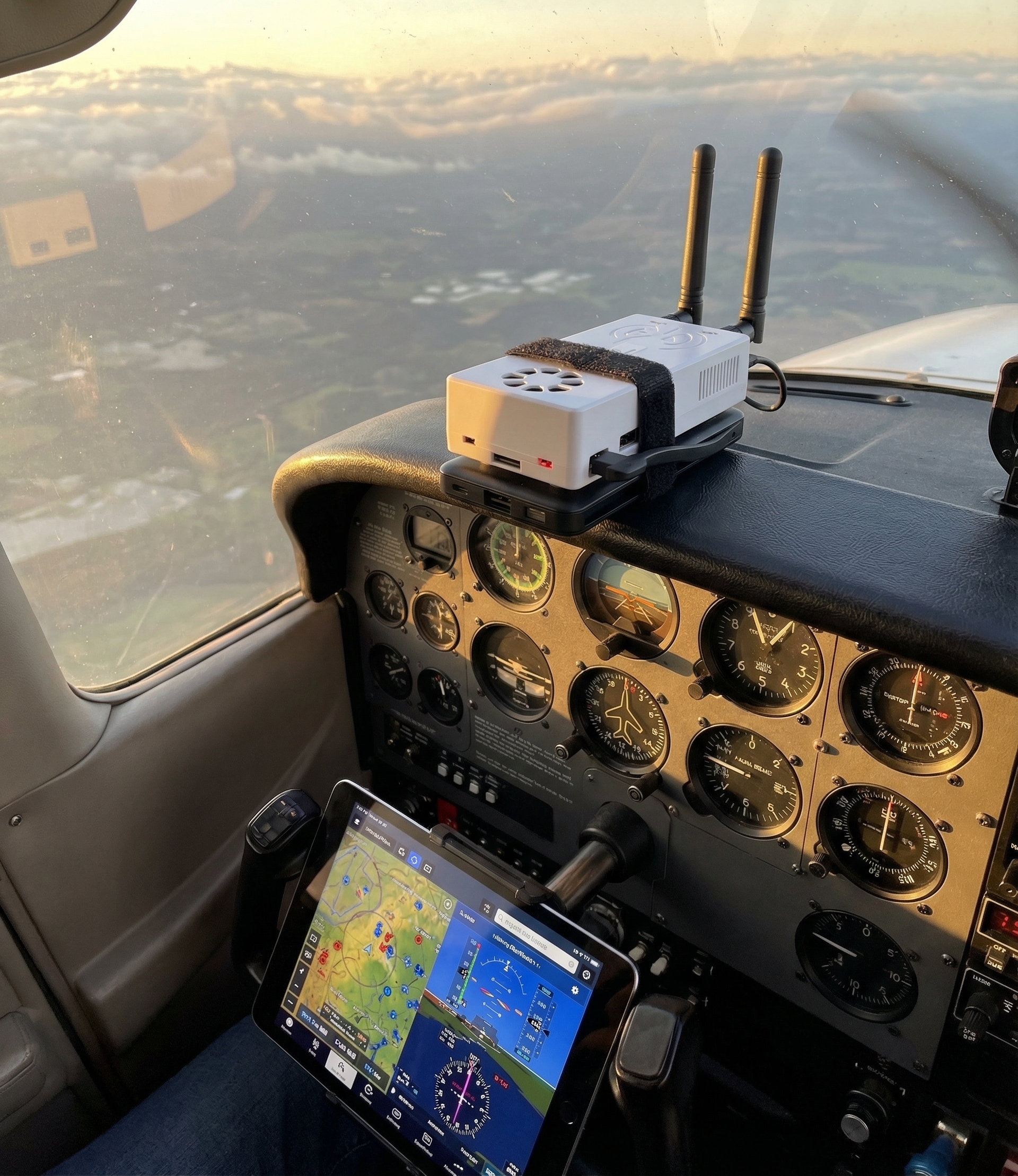
A portable receiver connected to ForeFlight® on an iPad is, by any reasonable measure, a practical ADS-B In solution. You see traffic. You see weather. You have the in-flight picture the NTSB has been pushing Congress toward for years.
The difference between a certified panel-mounted unit and a portable receiver, from a situational awareness standpoint, is close to zero. The difference in cost is not.
The $439 Argument
The NTSB Chair told Congress in 2025 that a $400 portable ADS-B receiver paired with an iPad was the affordable path for general aviation pilots to get real traffic awareness. She described a device that connects to any EFB over Wi-Fi, costs a fraction of panel-mounted alternatives, and requires no avionics shop installation.
That description matches the Stratux exactly.
The Stratux ADS-B receiver processes both 978 MHz UAT and 1090ES traffic simultaneously, delivers FIS-B weather (NEXRAD, METARs, PIREPs, TFRs), and sends everything to ForeFlight®, Garmin Pilot, WingX, or any other GDL-90-compatible EFB over Wi-Fi. It works in the US and Canada. It requires no subscription. It costs $439.99 for the pre-built unit with internal GPS, or you can build your own from components starting around $210.
It is, in every meaningful way, what Congress is trying to get more pilots to use.
Why This Matters Beyond the Mandate Debate
The legislative fight will continue. The ROTOR Act may be reintroduced. The ALERT Act still has to clear the full House and Senate. Military exemptions will be contested. This process moves slowly.
What doesn’t change: the traffic is already broadcasting. Every ADS-B Out-equipped aircraft in your vicinity is announcing its position right now. Whether you receive that information depends entirely on whether you have a receiver.
The NTSB has been pushing this recommendation for years. The technology works. The portable version costs less than a nice set of headsets. Congress is fighting over whether to require it, but it doesn’t need a mandate to be useful to you today.
Situational awareness doesn’t wait for legislation.
The Open Source Angle
There’s one more thing worth saying here. The Stratux is open source hardware. Every component is documented, replaceable, and community-supported. If the UAT radio fails, you swap it. If the GPS module goes out, you replace it for $20. If the software gets an update, the community ships it.
That’s not how sealed avionics boxes work. When those fail, you send them back to the manufacturer and wait. Right to repair isn’t just about tractors. It’s about whether the equipment in your cockpit can survive the real world.
We’ve been making the case for open-source, repairable ADS-B receivers since before the mandate debates started. The accident near Reagan National didn’t change the technology. It just made the argument harder to ignore.
Get ADS-B In Before Congress Makes It Mandatory
The ALERT Act is moving through Congress with explicit language protecting the use of portable ADS-B In receivers. The technology is proven. The cost is lower than a weekend at Oshkosh. And every aircraft transmitting ADS-B Out is already broadcasting its position. You just need something to receive it.
The Stratux ADS-B receiver with internal GPS is $439.99, ships ready to fly, and works with ForeFlight®, Garmin Pilot, WingX, and every other major EFB. No subscription. No avionics shop. No waiting for a mandate.
Traffic awareness is available right now. Whether you use it is up to you.