
If you’ve been reading aviation news lately, you’ve seen a lot of talk about ADS-B requirements. Here’s what’s actually being debated — and what it means for pilots who fly GA.
The January collision near DCA was a tragedy. Sixty-seven people died. And in the months since, Congress has been asking hard questions about why modern safety technology wasn’t doing what it’s supposed to do.
One of those questions keeps coming up: ADS-B.
If you fly GA, you’ve probably heard a lot of noise about ADS-B mandates lately. Some of it applies to you. A lot of it doesn’t. Let’s break it down clearly — because the “ADS-B” being debated in congressional hearings is a different piece than the ADS-B that makes your cockpit safer every flight.
Two Systems. One Name. Total Confusion.
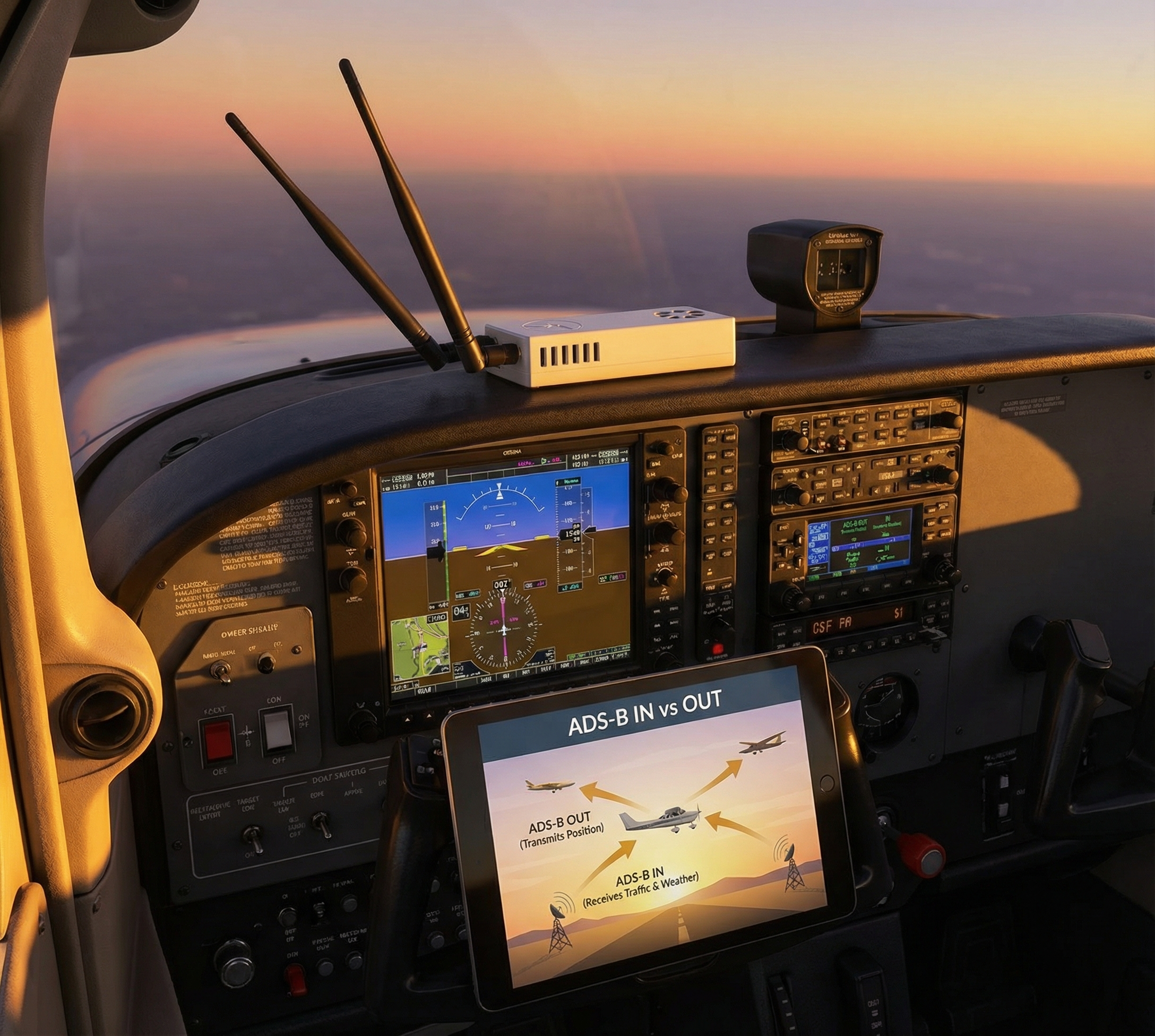
When most people say “ADS-B,” they’re actually talking about two separate, complementary systems:
ADS-B Out — The transmitter. Your aircraft broadcasts its position, altitude, speed, and identification to ground stations and other aircraft every second. Think of it as your aircraft saying “I’m here” to everyone around you.
ADS-B In — The receiver. Your cockpit equipment listens for what everyone else is broadcasting. Other aircraft positions, weather data from ground stations, PIREP uplinks. Think of it as your aircraft listening to the full picture around you.
You can have Out without In. You can have In without Out. Most of the post-DCA debate is about Out. Most of what makes Stratux valuable is In.
If you’re new to ADS-B entirely, here’s a primer on what ADS-B actually does and why the FAA mandated it.
What the Mandate Already Requires
Here’s something that gets lost in the news coverage: for most GA operations, the ADS-B Out mandate has been law since January 1, 2020.
FAA rule 14 CFR § 91.225 requires ADS-B Out equipment in:
- Class A airspace (above 18,000 ft)
- Class B airspace (major airports, like ATL, LAX, ORD)
- Class C airspace (medium airports with approach control)
- Class E airspace above 10,000 ft MSL (except below 2,500 AGL)
- Within 30 nm of Class B airports (the “Mode C veil”)
- Above the ceiling of Class B or Class C from the surface
If you fly a modern aircraft into most controlled airspace, you’re already compliant — or you already needed to be.
What’s being debated now is not a new mandate for GA. The current congressional focus is on military exemptions — specifically, whether military aircraft operating near civilian airspace should be required to use ADS-B Out the same way civilian aircraft are. The Black Hawk helicopter involved in the DCA collision was operating under a military exemption. That’s the gap that families and legislators are pushing to close.
What GA Pilots Should Actually Pay Attention To
The DCA collision is driving a broader ADS-B conversation, and that’s not a bad thing. But for GA pilots specifically, the question worth asking isn’t “do I need to comply with a new mandate?” — it’s “am I getting as much out of ADS-B as I could be?”
Here’s what most GA pilots still don’t know: ADS-B Out was only half the deal.
When the FAA mandated ADS-B Out in 2020, the promise was that pilots who also equipped with ADS-B In would gain something genuinely valuable: free, real-time traffic and weather data in the cockpit. No subscription. No data plan. No satellite fees. Just the FIS-B (weather) and TIS-B (traffic) data that FAA ground stations broadcast continuously.
That data is still out there. FAA ground stations are still broadcasting it. And every flight you take without an ADS-B In receiver is a flight where you’re missing free information you paid for (through avgas taxes and landing fees) to build.
ADS-B In: The Piece You’re Missing
Here’s what an ADS-B In receiver gives you in the cockpit:
Traffic (TIS-B): Positions of other ADS-B Out-equipped aircraft around you, updated every second. No ATC radio required. No radar transponder interrogation. Just a live picture of who’s around you.
Weather (FIS-B): METARs, TAFs, winds aloft, AIRMETs, SIGMETs, TFRs, and NEXRAD radar — all broadcast free from FAA ground stations. This is the data that used to require a $50/month XM Weather subscription.
AHRS (Attitude Heading Reference System): Some receivers also include synthetic attitude data — a valuable ~$20 backup when you want additional situational awareness.
The catch: none of this shows up on your iPad or EFB without a receiver in your cockpit pulling it in.
The Affordable Path to Full Situational Awareness
For a long time, “equip with ADS-B In” meant buying a $500–900 sealed receiver that you couldn’t repair, update yourself, or understand at a component level.
That changed in 2015 when the open-source community built a better option.
Stratux is an open-source ADS-B In receiver that runs on commodity hardware. The software is maintained by a community of pilots and engineers who actually use it. The hardware is repairable — every component is replaceable if something fails. And the cost is a fraction of proprietary alternatives.
This is the same philosophy as the Framework Laptop — build it so you can fix it instead of replace it. When your GPS module fails, you replace the $15 module, not the whole unit.
Crew Dog Electronics builds Stratux receivers that are ready to fly out of the box — no kit assembly required, no Raspberry Pi wrangling. Connect it to your iPad running ForeFlight® (or another compatible EFB), and you have live traffic and weather in the cockpit for a one-time cost. No subscription. No renewal. No vendor holding your safety data hostage.
It works in the US and Canada (Canadian CIFIB towers broadcast the same FIS-B data). Setup with ForeFlight takes about 5 minutes.
The Point
The DCA collision was a tragedy, and the congressional response to close military ADS-B loopholes is appropriate. But for GA pilots watching that news coverage: your compliance question was answered in 2020.
The better question is whether you’re flying with the full picture. ADS-B Out tells the world you’re there. ADS-B In tells you where everyone else is.
If you’re flying IFR or into busy airspace without an In receiver, you’re operating with half the information available to you — information that’s being broadcast for free, waiting for you to pick it up.
That’s a solvable problem. And it doesn’t cost $900.
What ADS-B In Looks Like in the Cockpit
A Stratux ADS-B receiver picks up both UAT (978 MHz) and 1090ES traffic. Here’s what the setup looks like from unboxing to first signal.