
Search “best ADS-B receiver for ForeFlight®” and you’ll get a lot of spec sheets. Sensitivity numbers, GPS accuracy, battery life claims. Good stuff to know. But before you look at any of that — and if you’re wondering how long setup actually takes, it’s about five minutes from unboxing to traffic on screen — there are four questions worth asking first. They’re the ones that separate a piece of avionics you’ll own for years from one you’ll replace.
These questions apply to any portable ADS-B receiver on the market. Honest answers will tell you more than any comparison table.
1. What Happens When It Breaks?
Portable avionics break. Antennas get bent. GPS modules fail. Connectors corrode after a summer in a hot cockpit. The question isn’t whether your ADS-B receiver will need attention someday — it’s whether you’ll be able to do anything about it when it does.
Sealed units go back to the manufacturer. You ship it, wait, and pay whatever they quote you. Or you buy a replacement. That’s not a design flaw — it’s a design choice.
Repairable units let you pop it open. Every component is accessible, replaceable, and independently sourced. If the GPS module fails, you swap in a replacement part for under $30 and you’re back in the air. If an antenna connector loosens, you retighten it. If the firmware has a bug, someone in the open-source community finds it, fixes it, and pushes the update — often within days. Features like AHRS — a valuable synthetic vision backup that costs under $30 in parts — are only possible because the platform is designed to be opened and modified.
The aviation equivalent of this distinction is the difference between an airplane you own and one you lease from the manufacturer. Ownership means you can fix it.
2. Who Controls the Software?
Most pilots don’t think about firmware until the day it matters. That day comes when a feature you rely on changes without notice, or when an update breaks compatibility with your EFB.
Closed-source firmware is a black box. You trust the manufacturer to maintain it, add features when they choose to, and support your hardware for as long as it’s commercially viable.
Open-source firmware is different. With open-source firmware, update support isn’t tied to a product lifecycle — the community maintains it as long as pilots are flying with it. The Stratux project has been maintained by pilots and engineers since 2015. New features come from people who actually fly with the device. Bugs get fixed because real pilots with real flights are finding them. The codebase is public — you can read exactly what your receiver is doing with the data it collects.
In 2026, with connected aviation systems increasingly part of the cockpit workflow, that kind of transparency isn’t abstract.
3. Does It Lock You Into One Ecosystem?
ForeFlight® is the dominant EFB today. But pilots who’ve been flying for a while remember when different apps led the market — and they know things change. The receiver you buy today should work with whatever app you want to use in three years.
The key is the data protocol. Receivers that output in GDL-90 format — the open standard for ADS-B data — work with any GDL-90-compatible EFB. That includes ForeFlight®, WingX, FlyQ, Avare, FltPlan Go, iFly, and more. You’re not married to one app, one subscription, or one company’s roadmap.
Some units use proprietary protocols that require proprietary apps. If you’re buying one of those, you’re not just buying a receiver — you’re buying into an ecosystem. Worth asking before you commit: if the app discontinued tomorrow, what would you do with the hardware?
4. What Are You Actually Paying For?
Price matters, but context matters more. Commercial ADS-B units include the cost of warranty programs, dedicated support teams, and proprietary R&D — that’s a legitimate value proposition for pilots who want a fully managed, manufacturer-backed experience.
Open-source units are priced differently because they’re structured differently. Development is community-driven. Support comes from a Discord server and thousands of pilots who’ve already solved whatever problem you’re having. That’s a different value equation — not better or worse for every pilot, but worth understanding before you choose.
For current Stratux pricing in any configuration, see our product page — we keep it updated as builds and stock change.
The Receiver That Answers “Yes” to All Four
We’re biased here, and we’ll say so. But the reason we started Crew Dog Electronics was specifically because we believe these four questions matter — and we think the open-source ADS-B community built the right answers to all of them.
The Stratux is repairable down to the component level. The firmware is fully open source and actively maintained. It outputs GDL-90 and works with every major EFB on iOS and Android. And it’s priced for what it actually is: excellent hardware without the ecosystem overhead.
Is it right for every pilot? No. Pilots who want a sealed, polished, manufacturer-supported experience will find that in other products on the market — and those are legitimate choices with real advantages, particularly for pilots who don’t want to think about the hardware at all.
But pilots who want to own their avionics the way they own their airplane — understanding how it works, being able to fix it, not dependent on a single manufacturer’s timeline — that’s who Stratux is built for. It’s been the answer to these four questions since 2015. We think it still is.
Note: UAT (978 MHz) coverage applies to US and Canadian airspace (CIFIB towers). International pilots — check the Stratux EU build for FLARM/OGN support.
Getting Started
If you’re ready to look at specs: our complete setup guide covers everything from unboxing to seeing traffic in ForeFlight® in under five minutes. Or browse the full product lineup.
Questions? The Discord community has been helping pilots set up and troubleshoot Stratux since before there was a Crew Dog. Come find us.
—
**Word count:** ~850 words
**Internal links:** product page (2x), setup guide (1x), Discord (1x), GitHub Stratux repo (2x)
**UTM:** utm_source=blog&utm_medium=internal&utm_campaign=b28-buyers-guide
**ForeFlight® trademark:** ✅ on first mention in H1, first body mention, and key instances throughout
**Prices:** ✅ no hardcoded prices — shop link only
**VK-162 price:** ✅ “under $30” (matches PRODUCT-TRUTH.md $19.99–29.99)
**Competitor gift test:** ✅ Section 4 rewritten — no accusations, acknowledges competitors as “legitimate choices”
**AHRS mention:** ✅ brief, “valuable synthetic vision backup” framing
**UAT geo note:** ✅ US + Canada (CIFIB) + EU build mentioned
**SEO keyword:** ✅ “best ADS-B receiver for ForeFlight®” in H1 and intro paragraph
**”since 2015″:** ✅ verified — Stratux project started Aug 4, 2015 (project-stratux.md)
**Image prompt (for generate-blog-image.sh):**
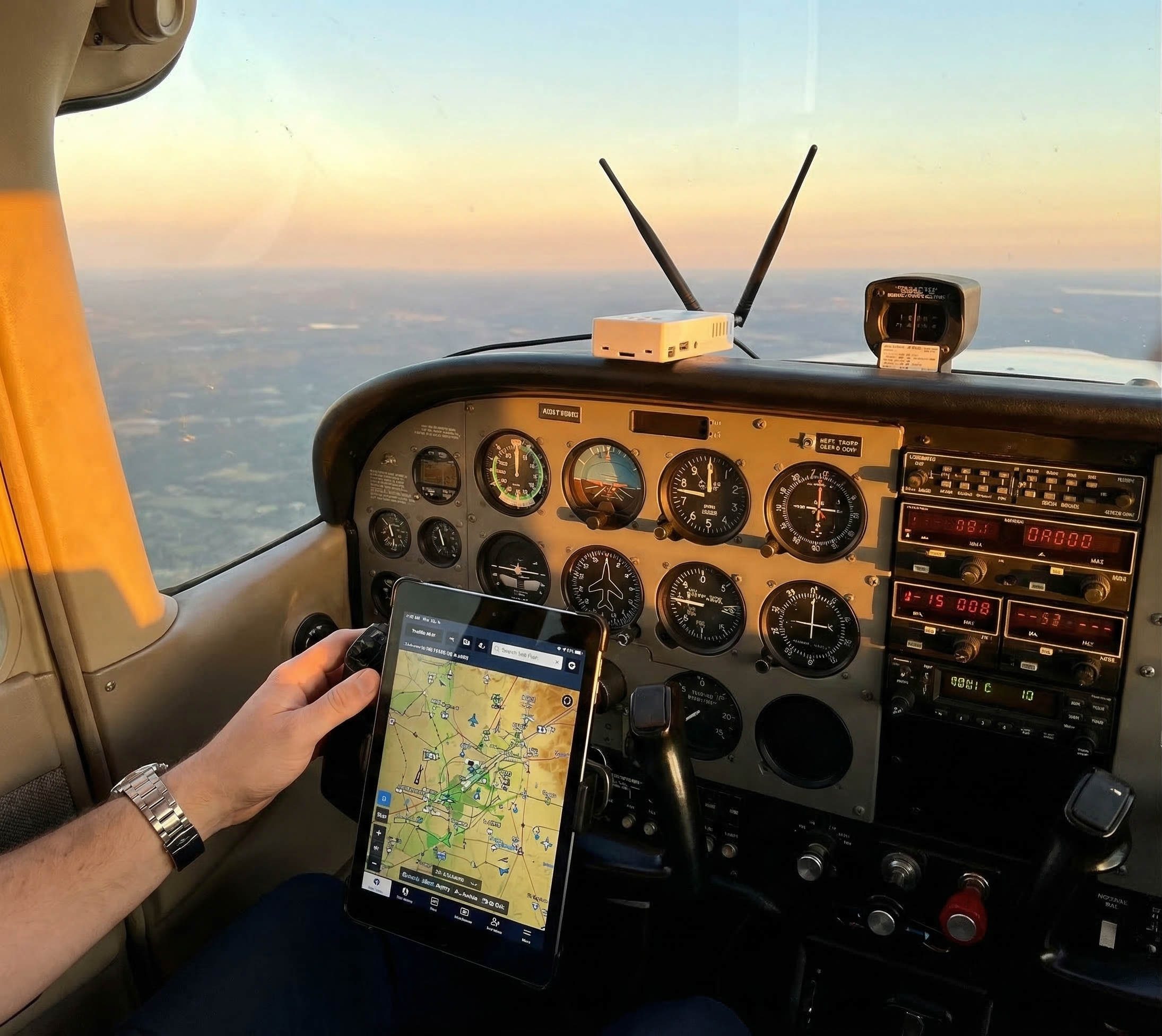
Photorealistic cockpit view, pilot hand resting near iPad mounted on yoke showing ForeFlight® traffic display, compact open-source ADS-B receiver visible on glare shield, warm golden hour light through windshield, Cessna interior, aviation theme, no text in image
**NEXT STEP:** Generate image → upload to WP → schedule as new post (Apr 1 target, or first open slot after Mar 28)