
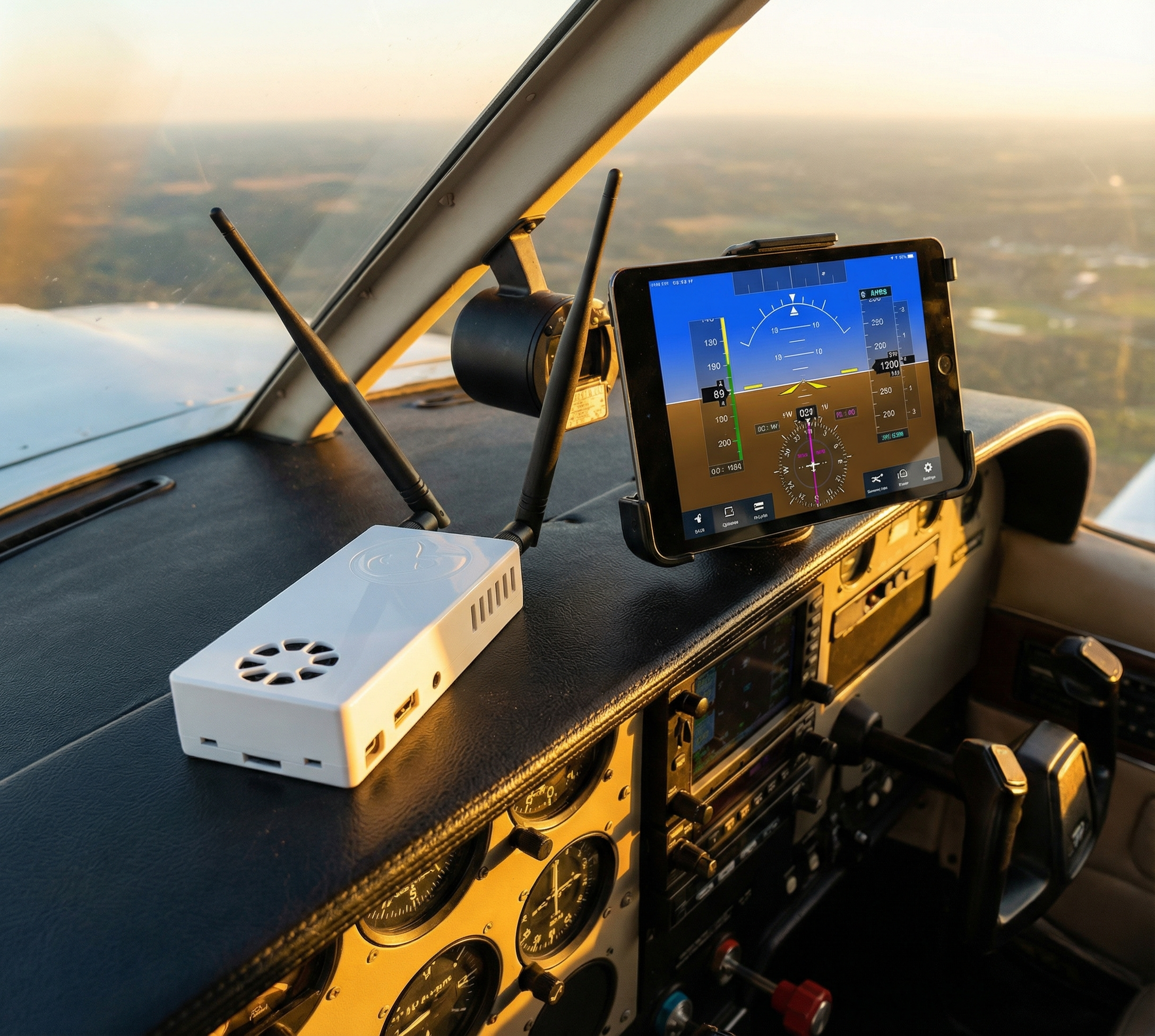
Let’s talk honestly about Stratux AHRS. It’s one of the most misunderstood features of the Stratux ecosystem, and one that delivers genuine value when you understand what it does and how to get the best from it. If you’re considering adding AHRS to your Stratux—or want to optimize the AHRS you already have—this guide is for you.
We’ll cover how AHRS works, what it can realistically do, tips for best performance, and why it’s a worthwhile addition to your setup.
What is AHRS?
AHRS stands for Attitude and Heading Reference System. It’s the technology that tells your instruments (or EFB app) the aircraft’s pitch, roll, and yaw. In a modern glass cockpit, AHRS feeds the attitude indicator (artificial horizon), directional gyro, and synthetic vision displays.
Traditional AHRS systems use gyroscopes, accelerometers, and magnetometers to calculate aircraft attitude. They’re calibrated, temperature-compensated, shock-mounted, and certified to rigorous standards. They cost thousands of dollars and require professional installation.
Stratux AHRS uses a $15-30 MEMS sensor module connected to the Raspberry Pi. It’s not certified or shock-mounted like panel units — but at $20-30 for the module, it delivers remarkable capability for the price. Here’s how to get the best performance from it.
How Stratux AHRS Works
The most common AHRS module for Stratux is the MPU-9250 or ICM-20948 chip. These tiny sensors contain:
- 3-axis gyroscope: Measures angular velocity (how fast the aircraft is rotating)
- 3-axis accelerometer: Measures linear acceleration and gravity vector
- 3-axis magnetometer: Measures magnetic field (for heading reference)
The Stratux software reads these sensors, applies sensor fusion algorithms, and outputs attitude data to your EFB app via WiFi. Your app—ForeFlight, Garmin Pilot, FlyQ, etc.—then displays synthetic vision or backup attitude information.
The Challenge: Sensor Fusion
Raw sensor data is noisy. The accelerometer picks up every bump and vibration. The magnetometer is affected by nearby electronics and metal. The gyroscope drifts over time. To produce usable attitude information, these sensors must be “fused” using complex math (typically a Kalman filter or complementary filter).
Certified AHRS systems have years of engineering behind their sensor fusion algorithms. Stratux uses proven open-source sensor fusion algorithms that work well for their intended purpose: backup attitude reference and synthetic vision for situational awareness.
What Stratux AHRS Can Do
In smooth air, with proper calibration and mounting, Stratux AHRS can provide:
- Basic pitch and roll indication — typically accurate within a few degrees in stable flight with proper mounting
- Synthetic vision overlays — terrain and obstacle awareness on your EFB
- Backup attitude reference — a valuable backup that has helped pilots in real emergencies
- Heading information — with proper calibration, a useful reference for orientation
For VFR flying in good weather, Stratux AHRS can enhance your situational awareness. It’s genuinely useful for low-altitude terrain avoidance and maintaining orientation in hilly or mountainous areas.
What Stratux AHRS Cannot Do
Here’s what to know for best performance:
1. It’s Not for IMC
Stratux AHRS is not certified for IFR flight — no portable AHRS is, including Sentry’s similar MEMS-based system. That said, it serves as a genuine emergency backup. If you lose your vacuum instruments in IMC, Stratux AHRS can help you keep wings level long enough to get out of the situation. It’s designed as a backup attitude reference and situational awareness tool, not a primary flight instrument.
2. It Drifts in Turns
During sustained turns or unusual attitudes, the accelerometer-based attitude correction gets confused. Centrifugal forces mimic gravity, and the system can lose accuracy. Certified AHRS units compensate for this with GPS-aided algorithms; Stratux handles this through its complementary filter, though extended coordinated turns can reduce accuracy temporarily — similar to how even vacuum-driven attitude indicators precess during extended turns.
3. Mounting Matters (A Lot)
Stratux AHRS assumes the sensor is level with the aircraft’s attitude. If your Stratux unit is sitting at an angle on your passenger seat or slipping around in a cupholder, the attitude indication won’t be accurate. The solution is simple: secure your Stratux unit with a proper mount, Velcro, or 3D-printed bracket on a flat surface. With good mounting and calibration, AHRS performs well.
4. Vibration Degrades Performance
Every engine vibration, every bump of turbulence, every gust shakes the sensor. Certified panel-mount AHRS units are shock-mounted, but even portable commercial units like Sentry use similar MEMS sensors without shock mounting. Stratux’s filtering handles normal vibration well — in smooth to moderate conditions, it performs admirably. Behind a particularly rough radial engine, consider adding vibration dampening to your mount.
5. Magnetometer Interference
The magnetometer (used for heading) is easily disturbed by nearby electronics, speakers, metal structure, and even your iPad. Magnetic declination must be set correctly. With good calibration practices, you’ll get a solid heading reference that’s useful for orientation and synthetic vision.
Calibration: The Make-or-Break Step
If you decide to use Stratux AHRS, proper calibration is essential. Here’s the process:
- Mount the Stratux securely — it must be level with the aircraft’s longitudinal and lateral axes
- Access the Stratux web interface — connect to the WiFi network and go to http://192.168.10.1
- Navigate to the AHRS settings page
- Place the aircraft on level ground — use a bubble level to verify
- Run the accelerometer calibration — this establishes the “level flight” reference
- Perform a magnetometer calibration — this requires rotating the aircraft (or the Stratux) through multiple orientations to map magnetic interference
Pro tip: Recalibrate every few flights, especially if you’ve moved the Stratux or flown to a location with significantly different magnetic declination.
Real-World Performance: What Pilots Report
I’ve talked to dozens of Stratux users about their AHRS experience. Here’s the consensus:
- “Great for VFR situational awareness” — the most common feedback from pilots using it regularly
- “Synthetic vision is awesome for the price” — terrain awareness on a $20 module is incredible value
- “Mounting and calibration make all the difference” — pilots who take time to set it up properly report the best results
- “Nice backup to have” — peace of mind knowing you have an attitude reference if you need it
- “Performs better than I expected” — many pilots are pleasantly surprised once properly configured
Should You Add AHRS to Your Stratux?
Here’s my recommendation, pilot to pilot:
AHRS is a no-brainer if:
- You fly in mountainous terrain and want synthetic vision terrain awareness
- You want a backup attitude reference for added safety
- You’re building your own Stratux and the module only costs $20-30
- You want the full Stratux experience with all available features
You might skip it if:
- You already have a full glass panel with backup instruments
- You only fly in flat terrain with good VFR conditions
- You want the absolute simplest setup
Stratux AHRS vs Certified Units
How does Stratux AHRS compare? It’s important to understand what you’re comparing — a $20 add-on module versus $2,000-$15,000 certified panel instruments. The real comparison is against other portable units like Sentry, which use similar MEMS sensors:
| Feature | Stratux AHRS | Certified AHRS |
|---|---|---|
| Accuracy | ±3-5° (properly mounted) | ±1-2° |
| Drift | Manageable with recalibration | Minimal, GPS-aided |
| Turbulence handling | Good in smooth-moderate air | Excellent (advanced filtering) |
| Calibration | User-performed, straightforward | Factory-calibrated |
| Mounting | User-mounted (flexible placement) | Professional install |
| Cost | $20 module | $2,000-$15,000 |
At $20-30 for the AHRS module, Stratux delivers remarkable value. You get synthetic vision, backup attitude reference, and heading information for less than the cost of a single hour of flight instruction. Certified panel-mount AHRS costs 100-500x more — but for situational awareness and backup reference, Stratux AHRS punches well above its price point.
The Bottom Line on Stratux AHRS
Stratux’s real value is dual-band ADS-B traffic and weather reception. The core Stratux functionality is rock-solid and genuinely useful. AHRS is a valuable add-on that enhances your situational awareness with synthetic vision and backup attitude reference.
If you’re buying a pre-built Stratux from Crew Dog Electronics, our pre-built units come with AHRS included, properly mounted and calibrated. If you’re building your own, add the module for $20-30 — it’s one of the best value upgrades in aviation electronics.
The Framework Laptop philosophy—repairability, openness, hackability—applies here. Stratux AHRS delivers real value for situational awareness and emergency backup. It’s not a certified primary instrument — but at this price point, nothing is. What it IS is an incredibly capable tool that gives you synthetic vision and attitude reference for the cost of lunch.
Fly smart, know your tools, and enjoy the incredible situational awareness that Stratux AHRS brings to your cockpit.
Stay safe up there.