
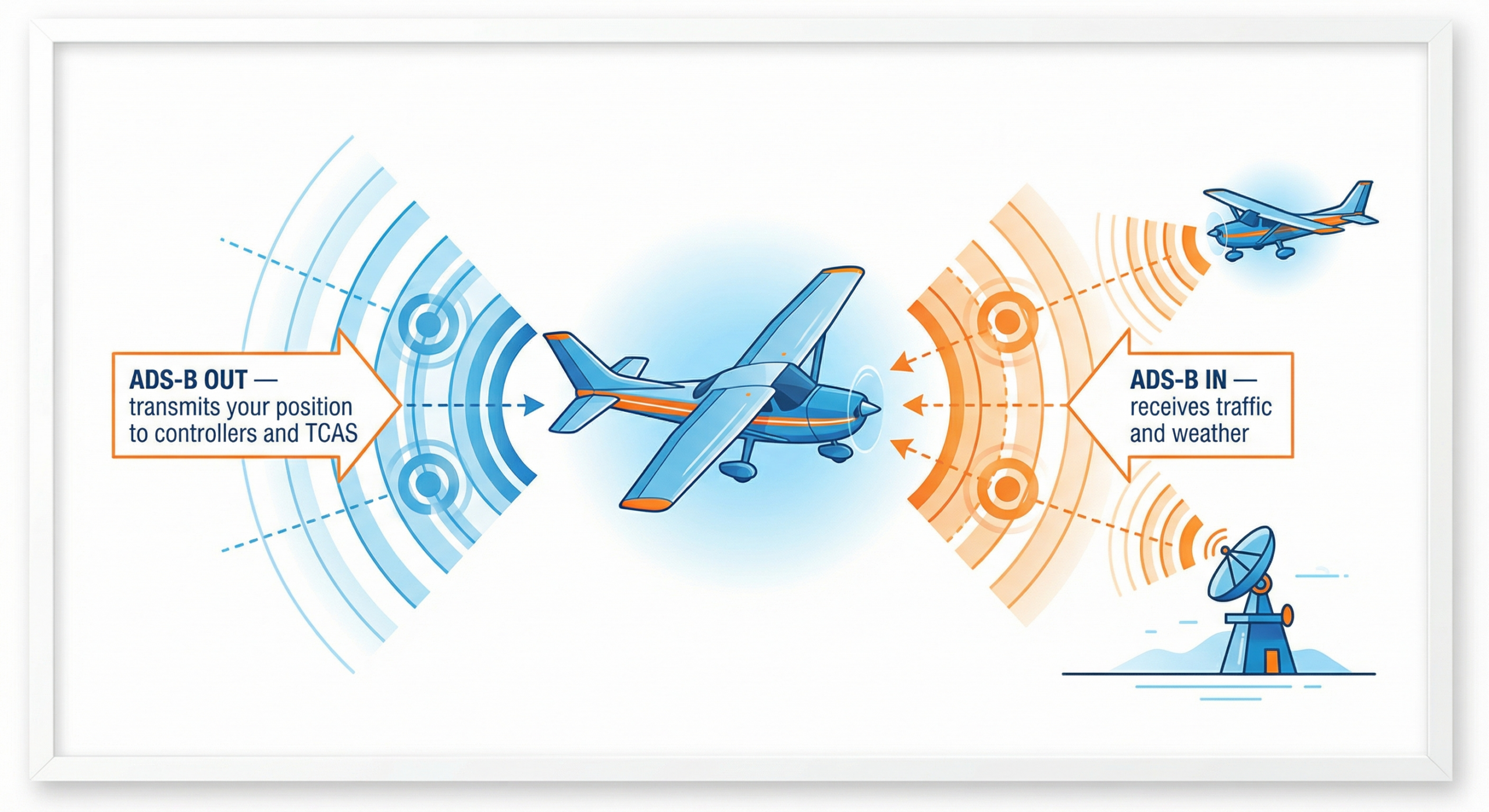
If you’ve been hearing about ADS-B for years but still aren’t 100% clear on the difference between “ADS-B In” and “ADS-B Out”—or what the FAA actually requires—you’re not alone. These terms get thrown around constantly, but the distinction matters for your wallet, your panel, and your safety.
Let’s break it down in plain English, pilot to pilot.
ADS-B Out: The FAA Mandate
ADS-B Out is what the FAA requires for most operations. Since January 1, 2020, aircraft flying in controlled airspace (Class A, B, and C, plus Class E above 10,000 feet MSL) must be equipped with ADS-B Out capability.
What does ADS-B Out do? Your aircraft broadcasts its position, altitude, velocity, and call sign to ATC and other aircraft. Think of it as a digital transponder on steroids. Instead of just responding to radar interrogations, your plane is actively announcing its presence to the world.
ADS-B Out Requirements:
- Must be certified and installed in your panel
- Transmits on 1090 MHz (for jets and high-performance aircraft) or 978 MHz UAT (for most GA aircraft below 18,000 feet)
- Requires a WAAS GPS source
- Must meet DO-260B or DO-282B standards
- Costs $1,500-$6,000+ for hardware and installation
The bottom line: If you fly in the airspace covered by the mandate, you need ADS-B Out. There’s no DIY option here—this is certified avionics territory. Popular solutions include Garmin GTX 345, Stratus ESG, FreeFlight RANGR, and uAvionix tail Beacon.
ADS-B In: Free Traffic and Weather
ADS-B In is the receiver side of the equation—and this is where things get interesting for budget-conscious pilots. ADS-B In lets you receive:
- Traffic: See nearby aircraft broadcasting ADS-B Out (both 1090 and 978 MHz)
- Weather: FIS-B services including NEXRAD radar, METARs, TAFs, winds aloft, AIRMETs, SIGMETs, and TFRs
- TIS-B traffic: ATC rebroadcasts non-ADS-B traffic in your area (requires you to have ADS-B Out)
Here’s the key difference: ADS-B In is NOT required by the FAA. It’s optional. But it’s incredibly useful for situational awareness, and thousands of pilots have added it to their cockpits.
ADS-B In Options:
- Portable receivers: Stratux, Sentry, Ping, SkyEcho—these connect wirelessly to your iPad or EFB
- Panel-mounted: Many ADS-B Out transponders include built-in ADS-B In (like the GTX 345 or Stratus ESGi)
- Hybrid: Some pilots install certified Out but use portable In to save on panel space and cost
What Does Stratux Provide?
A Stratux receiver is an ADS-B In device. It receives both 978 MHz UAT and 1090 MHz transmissions, giving you dual-band coverage. That means:
- You’ll see traffic from aircraft broadcasting on either frequency
- You’ll receive FIS-B weather (only transmitted on 978 MHz in the US)
- You’ll get GPS position data from the built-in GPS module
- Optional AHRS provides attitude information for synthetic vision and backup attitude reference
What Stratux does NOT provide: Stratux is receive-only. It does not meet the ADS-B Out mandate. You still need a certified transponder if you fly in controlled airspace. Think of Stratux as an amazing situational awareness tool, not a compliance solution.
TIS-B: The Bonus Feature
Here’s where things get clever. If you have ADS-B Out installed, ATC ground stations will rebroadcast nearby non-ADS-B traffic to you via TIS-B (Traffic Information Service-Broadcast). This means your ADS-B In receiver—like your Stratux—can see older aircraft that don’t have ADS-B Out yet.
Important caveat: TIS-B only works if:
- You have ADS-B Out (so ATC knows you’re there)
- You’re within range of a TIS-B-capable ground station
- There’s Mode C/S traffic in your area for ATC to rebroadcast
If you’re flying an aircraft without ADS-B Out, you’ll only see other aircraft that are transmitting ADS-B. You won’t get TIS-B service. That’s fine—you’ll still see most traffic in busy areas, since ADS-B adoption is nearly universal now.
The FAA Mandate: Who Needs What?
Let’s cut through the confusion with some real-world scenarios:
Scenario 1: VFR pilot flying under Class B
You’re flying a Cessna 150 out of a small airport, staying under the Class B shelf. You never enter controlled airspace.
Requirement: None. No ADS-B Out needed. But an ADS-B In receiver like Stratux still gives you weather and traffic awareness.
Scenario 2: IFR pilot in the system
You regularly file IFR and fly through Class C or B airspace.
Requirement: ADS-B Out is mandatory. Add a Stratux for bonus traffic and weather on your iPad.
Scenario 3: Weekend warrior at a Class D field
You fly VFR out of a towered airport, occasionally transitioning through Class C.
Requirement: ADS-B Out needed for Class C penetrations. Stratux adds significant safety value.
Scenario 4: Backcountry adventurer
You fly mountain strips and Class G airspace exclusively.
Requirement: No ADS-B Out required. A Stratux-equipped iPad gives you weather and traffic with no panel modifications.
Can You Get By with Just ADS-B In?
Legally? If you fly outside the mandate areas, absolutely. Practically? Stratux and other ADS-B In devices have become essential tools even for pilots who never touch controlled airspace.
Here’s why:
- Traffic awareness: See and avoid is easier when you can see
- Weather radar: Real-time NEXRAD on your iPad beats calling Flight Watch
- TFR avoidance: Don’t be that pilot who accidentally busts a presidential TFR
- Winds aloft: Actual winds in flight, updated continuously
- GPS backup: If your panel GPS fails, Stratux provides position
Cost Comparison: In vs Out
Let’s talk money:
| Equipment | Function | Cost |
|---|---|---|
| DIY Stratux | ADS-B In only | $210-230 |
| Pre-built Stratux | ADS-B In only | $379-449 |
| Garmin GTX 345 | ADS-B Out + In | $5,000-7,000 installed |
| Stratus ESGi | ADS-B Out + In | $4,000-6,000 installed |
| uAvionix tailBeacon | ADS-B Out only | $2,000-3,000 installed |
Many pilots choose a tailBeacon or SkyBeacon for Out (meeting the mandate) and add a Stratux for In (getting traffic and weather). Total cost: under $3,000, with no panel space consumed.
The Bottom Line
ADS-B Out is what you transmit—it’s legally required in most controlled airspace, and it must be certified equipment.
ADS-B In is what you receive—it’s optional but incredibly valuable, and portable receivers like Stratux offer a low-cost entry point.
If you’re flying in the mandate areas, you need Out. If you want better situational awareness (and who doesn’t?), adding In is one of the smartest investments you can make. And with options like Stratux starting under $400, there’s no reason to fly blind when the data is right there, free from the FAA.
Fly safe, fly informed.