
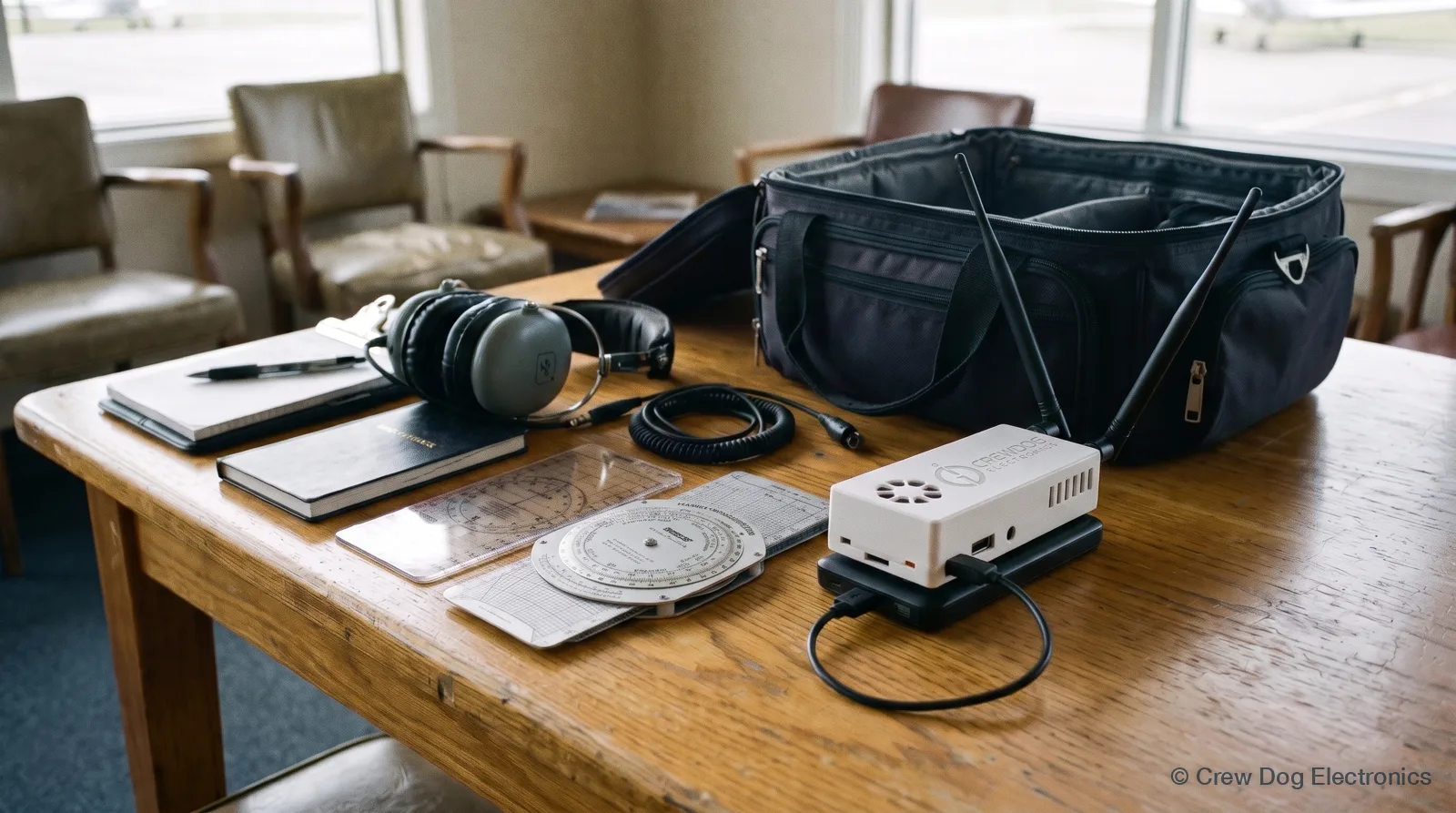
A student pilot flight bag starts small. For your first lesson you need a photo ID, a logbook, a headset and a pen. That’s it. The bag grows as you hit each stage of training, and the regs tell you exactly what has to be in it by the time you fly solo.
My advice as a former instructor: buy each thing when your training gets there. So here’s the bag by stage.
Before your first lesson
- Photo ID. You’ll need it on every solo and at the written, so it lives in the bag.
- A logbook. Paper or app. Your instructor logs every lesson in it.
- A headset. Ask your school if it lends them before you buy one. Try a few on if you can. Fit matters more than features for a 1.5-hour lesson.
- A pen, a kneeboard or small notepad, and water. You’ll be jotting down frequencies and the ATIS.
That’s the whole list. Charts, a tablet and an ADS-B receiver can all wait.
Before your first solo
Solo day brings paperwork you have to carry. Under 14 CFR 61.3, you need your pilot certificate (for you, the student pilot certificate) and a photo ID in your possession or readily accessible in the airplane. Most students also need a medical certificate, per 61.3(c). That section lists exceptions, like sport pilot training with a driver’s license. Ask your CFI which applies to you.
Don’t have the student certificate yet? Start the application early. Our sister site, Crew Dog Ground School, has a step-by-step guide on how to get a student pilot certificate.
Keep them in a zip pocket of the bag so they never come out. Then add a flashlight. You’ll want it for the preflight on your first early-morning lesson.
Before the FAA written test
The knowledge test needs two things on test day, per 61.35. You need an endorsement from an authorized instructor saying you finished the ground training or a home-study course and you’re ready. You also need an ID that shows your photo, signature and date of birth.
For studying, I’d skip the expensive boxed courses until you’ve tried the free stuff. Full disclosure: Crew Dog Ground School is ours. It’s free, runs in a browser, and is built for iPad. The private pilot practice test is timed like the real one and shows which areas you miss. Its study guide lays out what to study first. When your practice scores are steady, the scheduling guide walks you through booking the test and what you’re allowed to bring.
Put a plotter and a flight computer in the bag now. The guide lists both as allowed on test day, and you’ll use them for cross-country planning.
Before your first solo cross-country
Solo cross-country adds one more rule. 61.51(i)(2) says a student pilot must carry the logbook and the student pilot certificate in the airplane on every solo cross-country. Those hold your instructor’s endorsements, so they ride along every time.
You’ll also be planning longer routes, reading weather and handling airspace on your own. A tablet and an EFB app help most here:
- A tablet. A Wi-Fi-only iPad has no GPS of its own, which is fine if a receiver feeds it position. I wrote up which iPad works best for ForeFlight.
- An EFB app. ForeFlight’s Starter plan is $130 a year, and ForeFlight pitches it at new student pilots. My EFB explainer covers the other apps too.
- An ADS-B In receiver. It puts traffic and weather on the tablet, plus GPS for an iPad that lacks it. Nothing in the rules makes you carry one. But on your first solo cross-country, seeing traffic near an unfamiliar airport is a big deal.
Paper charts are still worth a spot in the bag as a backup. Batteries die.
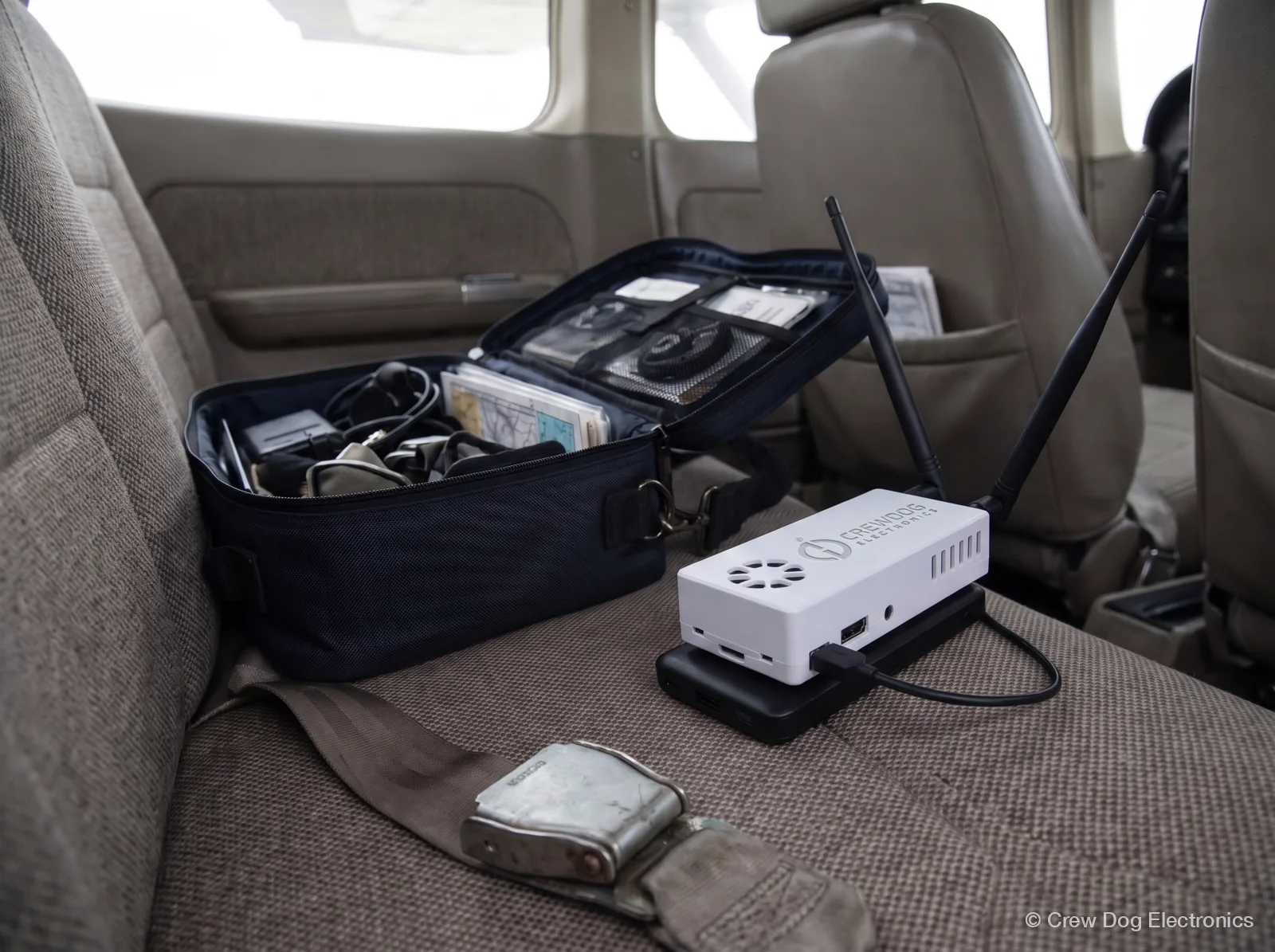
Pack a power bank rated for 2 A or more. A 1 A supply can make a Stratux reboot over and over.
What can wait
- A premium headset. Fly a rental or a mid-range one for your first 20 hours. Then you’ll know what bugs you.
- A yoke mount. A kneeboard holds a tablet fine in most trainers.
- A second tablet. One is plenty until your instrument rating.
Your Stratux when the time comes
Every Crew Dog Stratux is a dual-band (978 and 1090 MHz) ADS-B In receiver with WAAS GPS and AHRS. It works with ForeFlight, Garmin Pilot on iOS, iFly and the other big EFBs. There’s no subscription. Compare it against the field in our ADS-B receiver buyer’s guide, or see which Stratux fits you.
Shopping for a student pilot this season? Our gifts for pilots list sorts gear by budget.
Student pilot flight bag questions
What do student pilots need to carry when flying solo?
Your student pilot certificate and a photo ID, plus a medical certificate unless one of the 61.3(c) exceptions applies (14 CFR 61.3). On solo cross-countries, add your logbook and student pilot certificate in the airplane (61.51(i)(2)).
Do student pilots need ADS-B In?
No. The ADS-B rule covers ADS-B Out equipment in the airplane, not a receiver in your bag. Ground School explains the ADS-B Out rules, and our ADS-B In vs Out explainer covers what each one does.
What should I buy first?
A headset that fits and a logbook. Everything else can wait for the stage that needs it.
What’s in your bag that I missed? Drop us a note.